Reviews
Kokuyo Ing Cloud: Eight Years of Engineering Zero-Gravity Focus
How Kokuyo spent nearly a decade perfecting a chair that disappears under you
By the Furniblog Editorial Team·June 25, 2026·6 min read
The Tragic Inspiration: Engineers Leaving Work With Canes
Some of the most profound innovations in furniture design begin when someone witnesses a deeply troubling scene. For Kokuyo's design team, that moment arrived outside a Tokyo high-rise late one evening.
Designers Kinoshita and Maeda watched young software engineers exit their office after a long shift. Many couldn't straighten their backs. Some leaned against walls. A few even hobbled with canes—like elderly men, not professionals in their twenties and thirties.
The cause? Deep-focus work sessions lasting hours without a single shift in posture. The chair—meant to support the human body—had become a cage, freezing them in place and damaging their spines. This paradox became the painful starting point for the Kokuyo Ing series, and eventually for its flagship evolution: the Kokuyo Ing Cloud.
Born to Move: 360 Joints, 700 Muscles
Kokuyo's response to this crisis was rooted in human anatomy. The human body contains approximately 360 joints and more than 700 muscles—a structure designed for movement, not stillness. Yet the average modern worker sits for seven hours a day, and Japan ranks among the countries with the longest sedentary times globally.
Sitting motionless doesn't just stiffen muscles. It reduces blood flow, lowers brain activity, and undermines both health and creativity. Kokuyo reframed the problem: what if the definition of "sitting well" wasn't about holding a fixed posture, but about constantly changing posture?
Redefining Sitting as Movement
Most office chairs use strong metal springs to support the user's weight and push the backrest into position. But springs create resistance—a subtle but constant force that tenses muscles and disrupts concentration. Kokuyo set out to eliminate that mechanical pushback entirely, relying only on the user's body weight and gravity to enable fluid motion.
This was an enormous challenge. The chair had to respond even to the tiny movements of breathing—the rise and fall of the ribcage with each inhale and exhale. To make that vision real, Kokuyo embarked on an eight-year development journey.
Eight Years to Remove the Spring
Spending eight years developing a single office chair is almost unheard of in the furniture industry. Kokuyo's reason? To completely eliminate mechanical resistance and create a gliding mechanism powered only by gravity and the user's body weight.
After thousands of simulations and prototypes, the team succeeded in creating a balance-ball-like floating sensation inside the rigid frame of an office chair. The original Ing chair launched in 2017 with this breakthrough technology, and it proved the concept: sitting on Ing burned calories equivalent to walking 1.5 kilometers, all while keeping the body in gentle, constant motion.
The Ing Family: Office and Living
The Ing series evolved into two lines:
- Ing (office): Designed for professional workspaces, it gave office workers physical freedom while sitting.
- Ing Life: Built for home offices and living spaces, bringing the same healthy movement into kitchens, dens, and home desks.
Both models demonstrated that movement doesn't distract from focus—it enhances it.
Why the Ing Cloud Now?
Kokuyo received surprising feedback from Ing users: the chair's motion didn't just make them more comfortable, it made them more focused. This insight led to the development of the Ing Cloud in 2025—a flagship model designed to eliminate every trace of physical distraction and create a state of near-weightlessness.
The Technology Behind Zero Gravity
Triple Gliding: Following Every Movement
The original Ing used a gliding mechanism beneath the seat. The Ing Cloud takes this much further with a triple gliding system that tracks your body across three zones:
- The seat base glides as your pelvis shifts.
- The backrest adjusts dynamically to your spine angle.
- The armrests move with your arms and shoulders.
When you lean forward toward your screen, the seat tilts and the armrests follow your elbows. When you recline to think, the backrest gives gentle, continuous support. The chair becomes an extension of your body, responding organically to your posture like a joint—not a static frame.
3D Hammock Mesh: Freedom From the Frame
Traditional office chairs rely on rigid side frames to support mesh backrests. But those frames press into your shoulders and back when you stretch or twist—another source of physical noise.
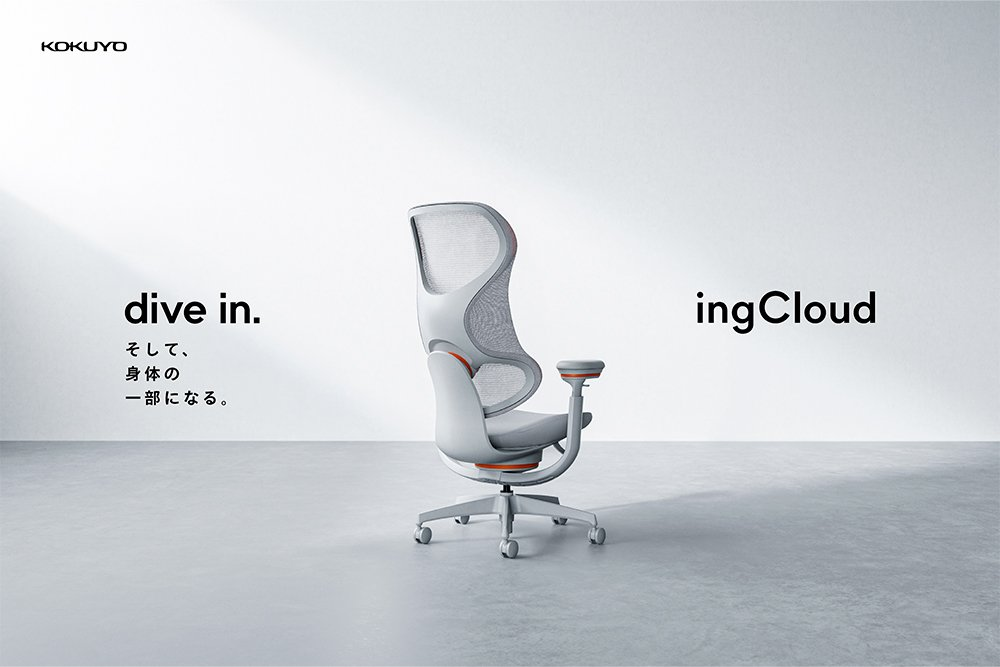
The Ing Cloud eliminates those side frames entirely. Its 3D hammock mesh backrest has no lateral constraints, allowing it to wrap around your torso and adapt to your body shape in three dimensions. The result is a floating, weightless sensation—like sitting in a suspended hammock—with lumbar support built into the lower back contour, requiring no manual adjustment.
Data-Proven Pressure Reduction
Kokuyo's lab testing shows dramatic improvements in pressure distribution. Where conventional chairs registered backrest pressure peaks of 110 (arbitrary units), the Ing Cloud measured just 43—a reduction of more than 60%. Pressure is spread so evenly across the back and seat that users report feeling almost no contact, as if suspended in mid-air. This frees the brain from monitoring discomfort, allowing complete mental immersion.
From Sitting to Wearing: A New Experience
The Chair You Wear, Not Sit On
Kokuyo's designers describe the Ing Cloud experience as closer to wearing a chair than sitting in one. It doesn't feel like a piece of furniture you rest upon—it feels like a second skin or a tailored garment that moves with you.
When the physical boundary between body and chair disappears, all that remains is your work, your thoughts, and your creativity.
Deep Work for Professionals
This near-weightless experience is especially valuable for professionals whose focus is their competitive edge: programmers working on mechanical keyboards, designers chasing fleeting inspiration, writers deep in composition. For these users, even a slight pressure point or restrictive backrest can break concentration.
The Ing Cloud's auto-fitting mechanism responds unconsciously to every posture shift, allowing the body to move freely while the mind dives deeper into flow states—what productivity researchers call deep work.
A Bold Claim: "You Can't Go Back"
Kokuyo's tagline for the Ing Cloud is provocative: "Once you experience it, you can't go back to other chairs."
It's not marketing hype. It's a confident assertion born from eight years of gravity research, thousands of pressure-mapping tests, and a floating sensation so distinct that once your body knows it, fixed chairs feel restrictive by comparison.
The journey that began with engineers limping home from work has culminated in a chair that offers creative professionals a kind of physical freedom they didn't know was possible.
Who Should Consider the Ing Cloud?
The Kokuyo Ing Cloud is ideal for:
- Programmers, designers, writers, and other knowledge workers who spend hours in deep focus
- Users who want motion and ergonomics without manual adjustments
- Anyone sensitive to pressure points, back fatigue, or postural stiffness
- Professionals upgrading from mid-tier ergonomic chairs and seeking flagship-level refinement
Because the Ing Cloud relies on movement rather than locking mechanisms, it pairs especially well with users who naturally shift posture throughout the day or who want a chair that encourages gentle activity rather than enforcing "correct" positions.
Final Thoughts
The Kokuyo Ing Cloud represents the intersection of biomechanics, materials science, and patient iteration. It's a chair that took eight years to perfect because the goal wasn't incremental improvement—it was the elimination of physical awareness itself.
For users seeking more traditional ergonomic support with extensive adjustability, models like the Steelcase Gesture or Herman Miller Embody remain excellent choices. But if you're curious about a fundamentally different sitting philosophy—one built on motion, weightlessness, and the disappearance of the chair beneath you—the Ing Cloud is worth experiencing firsthand.
When the chair becomes invisible, focus becomes inevitable.
Furniblog may earn a commission from links in this post, at no extra cost to you. See our affiliate disclosure.