When Architects and Car Designers Build Office Chairs: Okamura's MUKU and Contessa II
How Foster + Partners and Giugiaro brought new perspectives to task seating
By the Furniblog Editorial Team·July 9, 2026·4 min read
It's rare for an office furniture company to commission architects or automotive designers to create task seating. The disciplines seem worlds apart—one builds structures at the scale of skylines, another shapes machines that move at high speed, and both seem a long way from the daily reality of lumbar support and tilt mechanisms.
Yet Japanese manufacturer Okamura has done exactly that—twice. One collaboration is recent, unveiled in 2024. The other has been quietly shaping the brand's identity for over two decades. Both stories reveal what happens when expertise from outside the furniture industry is applied to one of the most utilitarian objects in the modern workplace: the office chair.
MUKU: An Architect's Take on the Task Chair
In June 2024, Okamura introduced MUKU at NeoCon in Chicago, the contract furniture industry's marquee trade event. The chair was designed in collaboration with the industrial design team at Foster + Partners, the London-based architecture studio best known for projects like Apple Park, the tech giant's California headquarters, and iconic structures including 30 St Mary Axe (the "Gherkin") in London and the Reichstag dome in Berlin.
Foster + Partners doesn't often venture into furniture design, and when it does, the results tend to reflect the firm's architectural sensibility: clarity of form, structural honesty, and an emphasis on sustainability. MUKU is no exception.
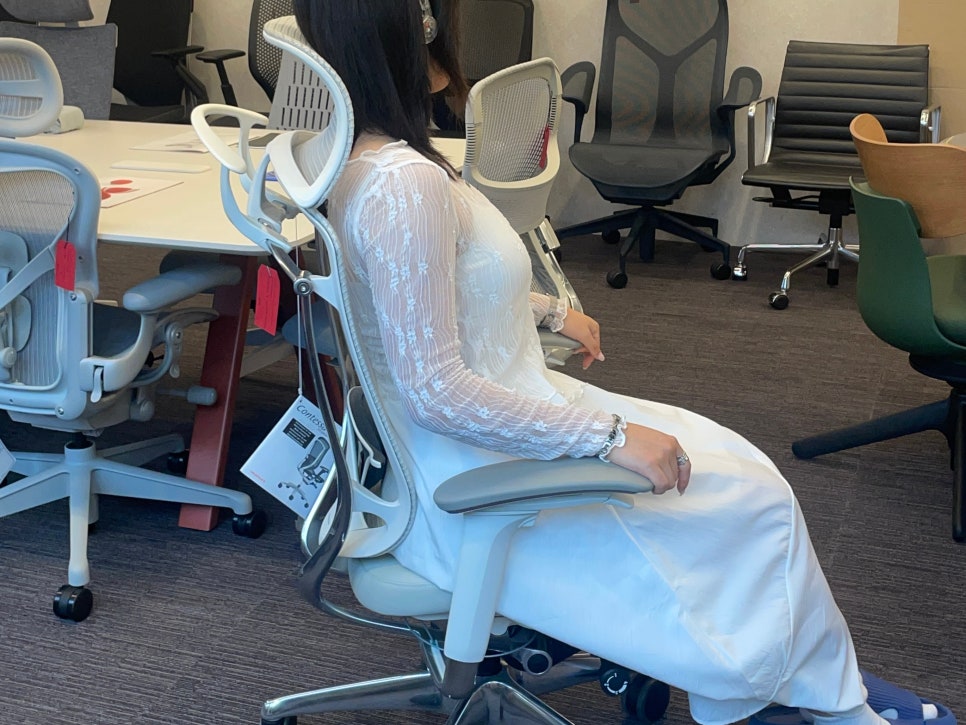
The chair's name comes from the Japanese word muku (無垢), meaning "pure" or "unadorned." That philosophy is visible in the silhouette, which strips away decorative elements in favor of clean lines and exposed structure. The frame is cast from recycled aluminum, and the backrest uses Okamura's proprietary Re:net fabric, a knit material made from reclaimed fishing nets.
At NeoCon 2024, MUKU won the Best of NeoCon Sustainability Award in the Conference Seating category—a recognition that underscores Foster + Partners' long-standing commitment to environmentally responsible design. The chair is intended for a range of settings: open-plan offices, conference rooms, and home workspaces.

Contessa II: A Car Designer's Vision for Seating
More than two decades ago, Okamura partnered with Italdesign Giugiaro, the storied Italian design consultancy founded by Giorgetto Giugiaro, to create the Contessa II. Giugiaro is a towering figure in automotive design—his portfolio includes the Volkswagen Golf, the Lotus Esprit, the DeLorean DMC-12, and dozens of other vehicles that defined their eras. In 1999, a global panel of automotive journalists named him Car Designer of the Century.
So what does a car designer bring to an office chair?
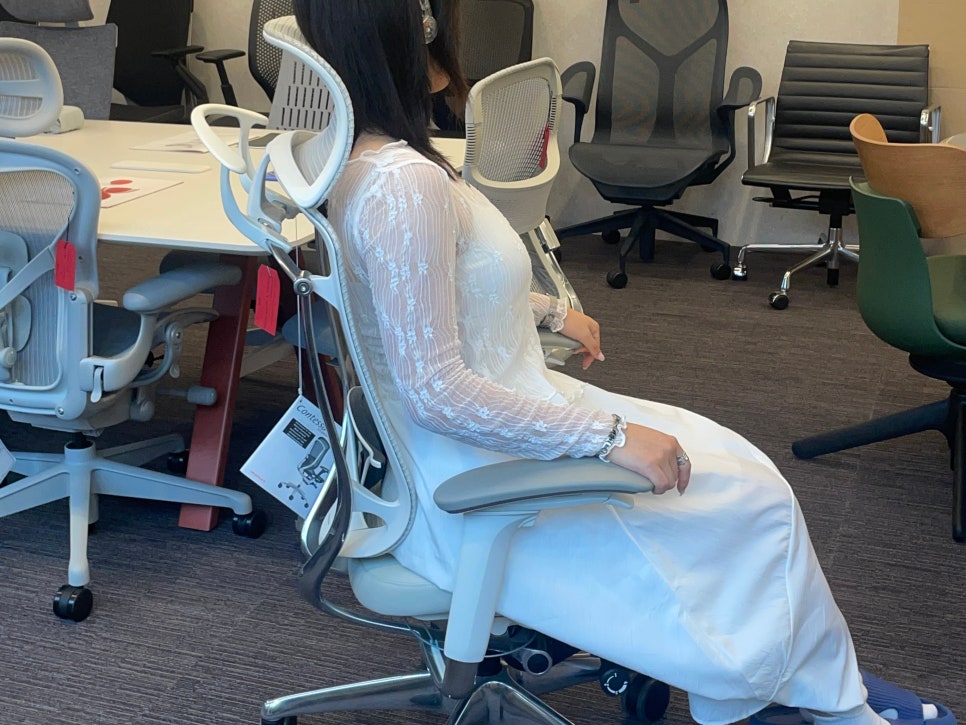
In the case of the Contessa II, quite a lot. The chair's paddle-style adjustment levers, located under the armrests, were inspired by Formula 1 gearshift mechanisms—tactile, intuitive, and engineered for quick adjustments without breaking focus. The exposed aluminum frame, which curves gracefully around the seat pan and up the back, recalls Giugiaro's concept car work, where he often left structural elements visible to celebrate engineering as part of the aesthetic.
The Contessa II features a dual-layer backrest: a flexible outer shell made from durable plastic, supported by a smooth aluminum inner frame that distributes weight and provides structural rigidity. The design earned a Gold IDEA Award in 2004, one of the most prestigious honors in industrial design, co-sponsored by the Industrial Designers Society of America (IDSA) and BusinessWeek.
The chair is also certified to BIFMA X5.1 standards and supports up to 300 pounds (approximately 136 kg), meeting commercial-grade durability requirements for office environments.
What These Collaborations Reveal
At first glance, MUKU and the Contessa II seem like outliers in Okamura's catalog. But they share a common thread: both were shaped by designers whose expertise lies outside traditional furniture design, and both benefited from that outsider perspective.
Architects bring an understanding of proportion, material integrity, and life-cycle thinking—skills honed by designing buildings meant to stand for decades. Automotive designers, meanwhile, specialize in ergonomics under motion, structural safety, and the integration of complex mechanical systems into sculpted forms.
These aren't just aesthetic exercises. When Foster + Partners designs a chair, it applies the same rigor it uses to plan a terminal or a tower. When Giugiaro shapes a backrest, he's drawing on decades of experience wrapping the human body in protective, dynamic structures at 200 kilometers per hour.
The result, in both cases, is task seating that doesn't look or feel like it came from a typical office furniture playbook.
Where to Experience Them
Photos and spec sheets can only convey so much. The texture of a Re:net backrest, the resistance of an F1-inspired paddle lever, the way an aluminum frame flexes under load—these are things you need to feel in person.
If you're in South Korea, Chairpark showrooms in Hannam, Gangnam, and Mapo offer hands-on access to Okamura's lineup, including both MUKU and the Contessa II. For readers elsewhere, authorized Okamura dealers often stock demo units, and it's worth seeking them out before making a decision.
Office chairs designed by architects and car designers may sound like a novelty. But in practice, these collaborations have produced some of the most thoughtfully engineered, visually distinctive task seating on the market—proof that sometimes the best way forward is to invite someone from a completely different discipline into the room.

Furniblog may earn a commission from links in this post, at no extra cost to you. See our affiliate disclosure.