Generation by Knoll – The Chair That Redefined Ergonomic Freedom
Formway's elastic design breakthrough meets Knoll's modernist precision
Overview
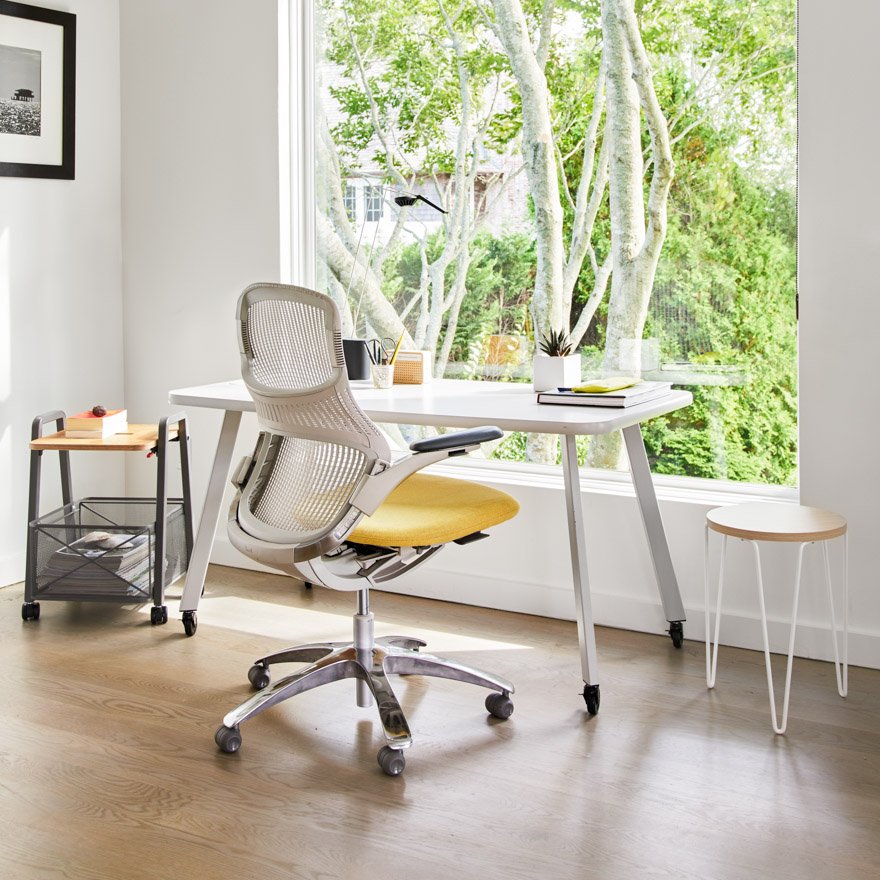
The Generation Chair, introduced in 2009, emerged from a radical premise: that sitting upright and facing forward is just one of many positions people adopt throughout the workday, and the design team created a seat that moves with you, as you move. Since its introduction, Generation has redefined seating by replacing the notions of how people "should" sit with the support users need to work freely, becoming the first chair to promote unrestrained movement.
Before Generation arrived, task chair design assumed there was one way we sit at work: back straight, head down, in the same position eight hours a day—until Knoll and Formway launched their groundbreaking chair that defined a new intersection of ergonomic industrial design by combining unrestrained comfort, ease of movement, and peak performance. The result is a chair that prioritizes adaptive, elastic response over prescriptive adjustment levers, powered by a distinctive figure-8 elastomer back and a frameless flex seat.
At a glance
Brand | Knoll |
|---|---|
Designer | Formway Design |
Year introduced | 2009 |
Overall dimensions | 28.5" W × 26" D × 39.25"–44.5" H |
Seat height range | 17.25"–22.5" |
Seat depth adjustment | 3 inches (15.75"–18.75") |
Weight | 39 lbs (with aluminum base; 37 lbs plastic base) |
Weight capacity | 300 pounds |
Key materials | Elastomer resin back, fabric seat, resin frame, aluminum or plastic base |
Adjustments | Seat height, seat depth, armrest height/width/pivot (HP arms), three-range tilt lock |
Warranty | 12 years (parts and labor), 24/7 multi-shift use |
Certifications | GREENGUARD Gold, BIFMA Level 3, SMaRT Sustainable Platinum, 4 LEED credits |
MSRP | $1,705 list; frequently discounted to ~$1,364 |
Country of manufacture | United States (Knoll LEED Gold-certified factory) |
The brand & its philosophy
Since 1938, Knoll has been recognized for creating modern furniture that inspires, evolves, and endures, steeped in the history of modernism with a vision carried forward today by the most talented contemporary designers. The company's guiding principle—"good design is good business"—reflects a Bauhaus-rooted philosophy that furniture should complement architectural space, not compete with it.
Knoll's office seating portfolio has long married modernist aesthetics with rigorous ergonomics. By the 2000s, the brand sought to push beyond the era's "prescriptive" task chairs—seats bristling with levers and dials—toward something more intuitive. For Knoll, it was time to take the idea of elastic design, where the product rearranges itself in response to its user, to a new level. Generation represents the culmination of that ambition: a chair that moves with you rather than asking you to adjust to it.
The designer and the design story
Founded in 1956, New Zealand-based Formway has been designing furniture for more than five decades; in 1979 the company redefined itself, developing a new identity and philosophy focused on team-based design and extensive research. Formway's designs are informed by insight gained through the observation and consideration of human behavior, and their user-centered approach marries a rigorous design process, an aesthetic sensitivity, and a passion for the environment.
Formway and Knoll first collaborated on the highly successful Life chair, introduced in 2002, celebrated for its sophisticated design, intuitive adjustments, responsive ergonomics, and sustainable attributes; building on these features, the two companies came together once again to develop the Generation chair, introduced in 2009. The design itself emerged from an in-house Formway charette—a 48-hour design challenge—with two Formway teams competing to give three-dimensional form to what had, up until then, been mostly abstractions; early ideas were presented to Knoll in June 2005.
Understanding that no combination of adjustment levers could make a chair equally comfortable in each of those positions, Formway sought to achieve an elastic design; after years of design and development spent considering and reconsidering every component, Formway arrived at a truly innovative design with a revolutionary new material for the chair's back and a form that anticipates and allows for a multitude of body positions.
Design language & aesthetics
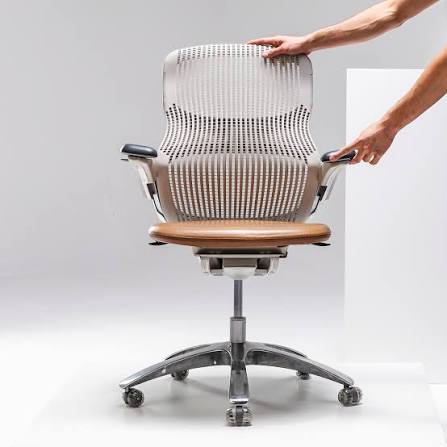
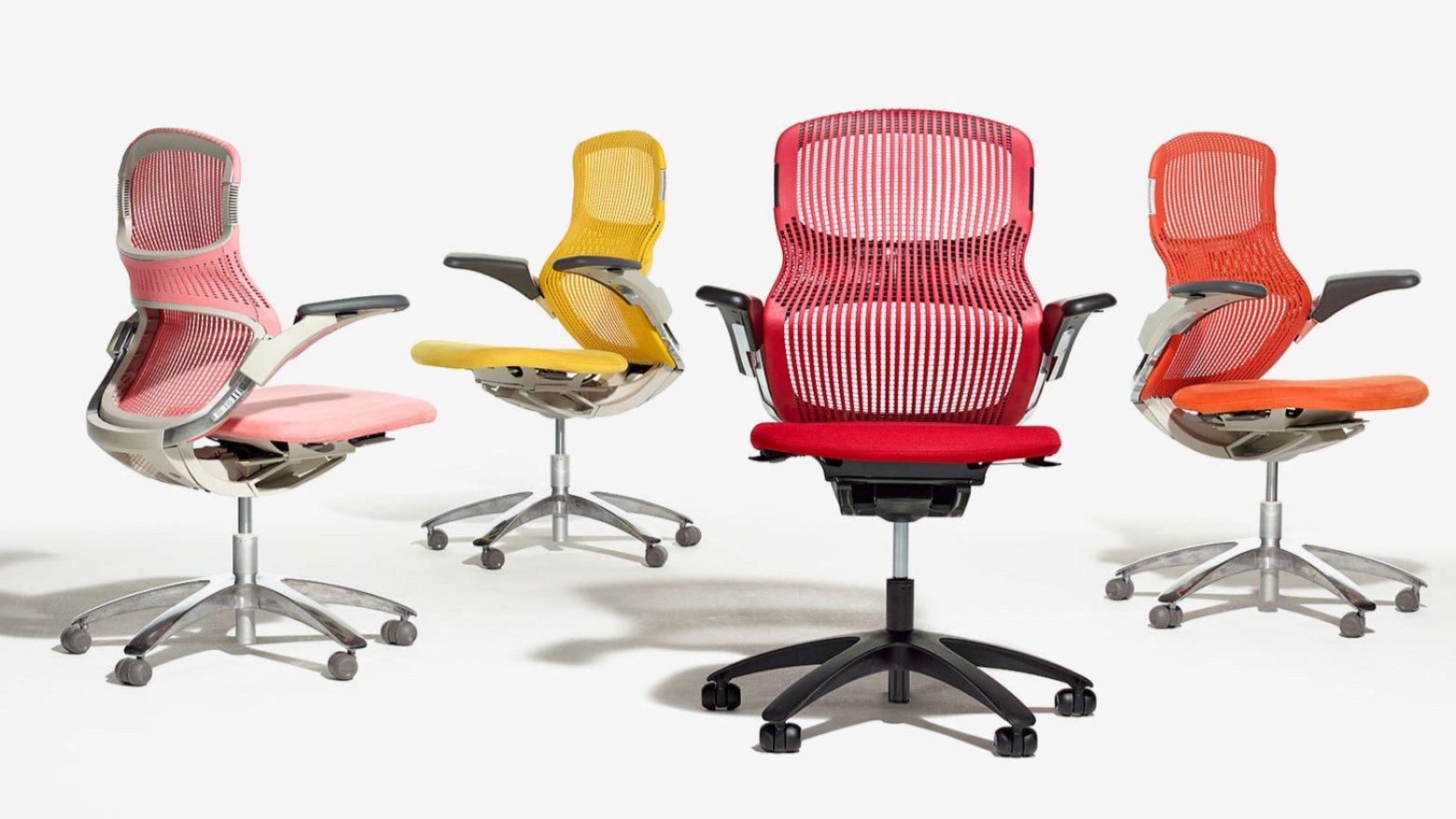
Generation reads unmistakably modern without tipping into cold technicality. The chair's most striking feature is its frameless elastomer back in a distinctive figure-8 silhouette—a sculptural element that immediately signals flexibility. Unlike traditional mesh or plastic-shell backs with visible perimeter frames, Generation's back appears to float, its curvaceous hourglass form suggesting movement even at rest.
The seat is equally soft-edged, with a gently contoured cushion that lacks the hard plastic rim of many competitors. Color options range from understated neutrals (black, charcoal, white) to vibrant accent tones (lemongrass, pebble, various upholstery fabrics), and an Anniversary Collection introduced six bright new finish options to communicate personality—explore a bold approach or create a reassuring classic identity. Base choices include burnished cast aluminum (which adds a premium sheen) or integrally colored plastic in light or dark finishes. The overall aesthetic is approachable, organic, and deliberately anti-technical—a chair that invites you to sit sideways, perch on the edge, or lean without guilt.
Ergonomics & how it supports the body
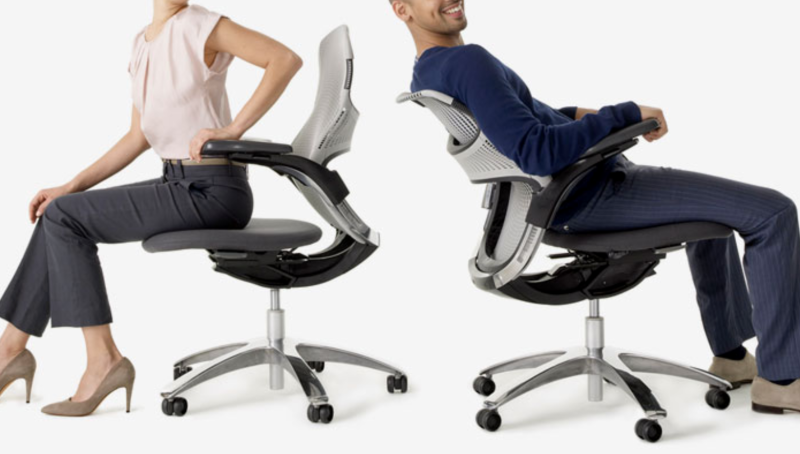
With its high-performance elastomer Flex Back Net and distinctive figure-8 structure, Generation supports many postures and allows for multidimensional movement, with the curvature of the figure-8 structure combined with the Net's unique properties enabling side-to-side flex and ensuring optimal localized support for shoulders and lumbar region. The back is not a passive cushion; it actively cradles and follows the spine's contour as you shift.
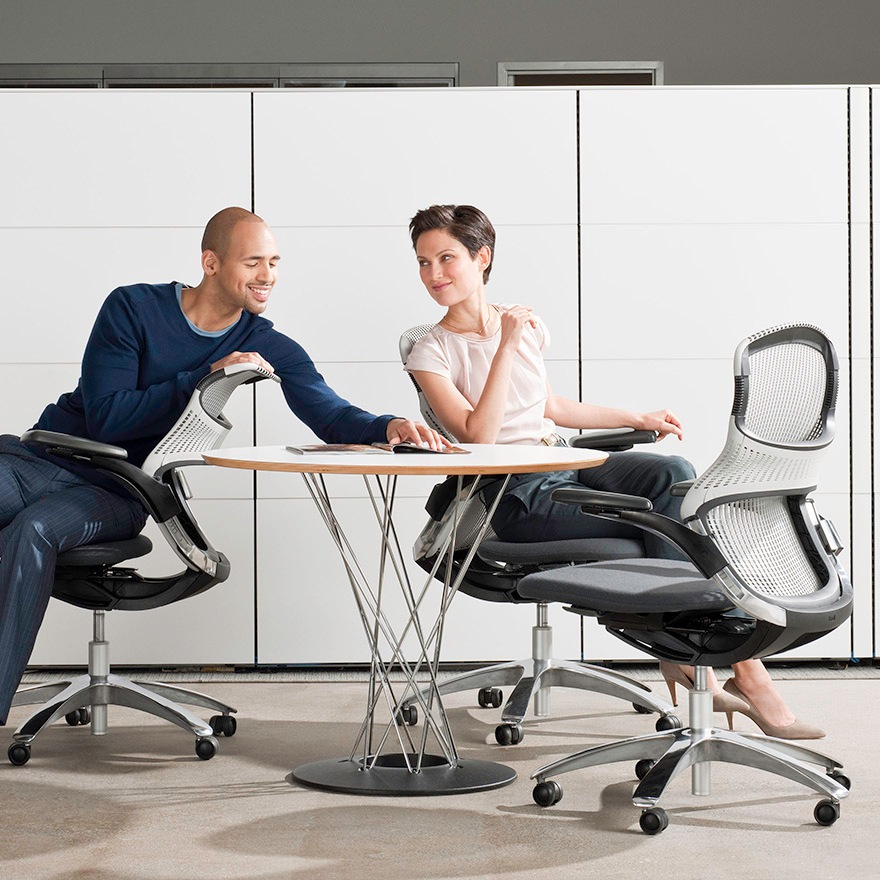
The Flex Seat offers 270 degrees of seat edge flex without a hard frame or obtrusive levers along the seat perimeter, as well as 3 inches of seat depth adjustment. This means the front and sides of the seat give under your thighs—especially useful if you perch forward or sit cross-legged. The Continuous Lumbar carries the lumbar support in the Flex Back through the design of the arms, resulting in seamless movement from upright to perched or side sitting positions.
The chair features a flexible lumbar support system so you can fidget and even turn around while seated; the back is made of a high-performance elastomer, so you can literally bend it and move in ways so that you are not confined by the chair. Reviewers frequently call out this freedom: one user noted that "the Knoll Generation is the best of the group [compared to Aeron and Mirra]…the flexible back does allow you to stay in the chair and still use it in a dozen different ways during the day."
Key adjustments & mechanisms
Generation deliberately minimizes the number of manual controls, relying instead on the chair's materials to adapt automatically. That said, several key adjustments remain:
Seat height: Pneumatic lever adjusts from 17.25" to 22.5" (standard cylinder; low and high cylinders also available).
Seat depth: 3 inches of depth adjustment (15.75"–18.75") , controlled by a simple slider beneath the seat front.
Tilt lock & tension: A tilt preference selector offers three ranges of recline movement —all the way back for maximum movement, middle for moderate recline, or forward for greater upright support.
Armrests: Two main options exist. Height-adjustable arms (up/down only) or high-performance arms (multi-directional) . High-performance arms lift via lever, slide to the desired height position, and feature free-float arm pads that easily move in width and depth and pivot. Users report the HP arms are worth the upcharge for fine-tuning typing posture.
Optional lumbar: Optional height-adjustable lumbar support can be added; grasp both sides and slide to the desired position.
The Dynamic Suspension, constructed from the same high-performance elastomer as the Flex Back Net, provides weight-compensated, smooth recline without the complexity of metal links or springs, with the inherent properties of this material—flex and durability—enabling an enhanced range of energizing, side-to-side movements.
Materials & build quality
Seat made of fabric, back of elastomer resin, frame of resin molding, and legs of resin or aluminum. The proprietary elastomer used for the Flex Back Net is the chair's defining innovation—a rubbery, high-performance polymer that stretches and rebounds without sagging over time. The Flex Back Net moves in unison with the user; it is lightweight and soft to the touch, yet extremely durable and won't sag over time.
Recycled materials are used in 40% of the chair with plastic base, 46% of the chair with aluminum base; recyclable materials make up 39% of the chair with plastic base, 54% of the chair with aluminum base. The frame is glass-reinforced nylon, a robust engineering plastic. Upholstery options include Generation-brand fabrics, various KnollTextiles, and leather (at a premium). The chair weighs 39 lbs with an aluminum base, 37 lbs with plastic , indicating solid construction without excessive heft.
Greenguard-certified and made in the U.S. at the Knoll LEED Gold-certified factory. Build quality is consistent with Knoll's reputation; castings are clean, seams tight, and the elastic back shows no visible stitching or glue lines. The chair ships fully assembled.
Sitting experience — what it actually feels like day to day
First-time sitters often express surprise—the back really flexes. Lean left, and the figure-8 twists to cradle your left shoulder blade; perch forward, and the back follows without forcing you upright. Perhaps the most striking thing you'll notice when you sit in the Generation chair is its incredibly lightweight, flexible back; whereas most office chairs give you a fair amount of resistance and structure when you lean back, the Generation's Flex Back is meant to be elastic and springy, but not so much so that you don't feel supported in any position.
The seat edge flex is subtler but tangible: cross your legs or perch to one side, and the seat rim yields rather than digging into your thigh. The signature elastomer flex backrest—instead of rigid plastic and fabric—stretches, twists, and moves dynamically with your torso to encourage healthy active seating and improve blood circulation. Over an eight-hour day, this freedom feels liberating, especially if you're prone to fidgeting or shifting positions during calls and deep work.
That said, some users accustomed to firm lumbar bolsters find the continuous lumbar less pronounced than a Steelcase Leap or Aeron's adjustable PostureFit. The optional add-on lumbar insert helps, but Generation's philosophy prioritizes omni-directional support over a single aggressive curve. One reviewer compared it to the Aeron, Mirra, and a custom zero-gravity chair: "so far the Knoll Generation is the best of the group…very firm seat support…the plus with this chair is the flexible back which does allow you to stay in the chair and still use it in a dozen different ways during the day."
Who it's for (and who should skip it)
Ideal for:
Multi-posture workers: If you switch between typing, sketching, phone calls, and collaborative screen-sharing, Generation's adaptive back shines.
Active sitters: People who fidget, shift, or sit cross-legged will appreciate the 270-degree seat edge flex and side-to-side back movement.
Design-conscious offices: The sculptural aesthetic and color options suit environments where furniture makes a statement.
Sustainability-focused buyers: SMaRT Sustainable Platinum, GREENGUARD Gold, BIFMA Level 3, and contributing to 4 LEED credits make this one of the greenest premium chairs.
Medium-sized users (5'4"–6'2"): The one-size design fits most users in this range well; extreme heights may need testing.
Consider alternatives if you:
Prefer firm, traditional lumbar bolsters: Generation's continuous lumbar is gentle; Steelcase Leap or Gesture offer more pronounced, adjustable curves.
Sit rigidly upright all day: If you rarely shift posture, you won't leverage the flex-back's benefits—a more structured chair may suffice.
Require extreme weight capacity: The 300-pound rating is typical for premium task chairs but not bariatric; Steelcase Leap supports up to 400 lbs.
Need ultra-breathability in hot climates: The upholstered seat is comfortable but less ventilated than full-mesh chairs like the Aeron.
Comparisons with key rivals
Chair | Price tier | Seat/Back | Adjustments | Standout strength |
|---|---|---|---|---|
Knoll Generation | ~$1,364–$1,705 | Fabric seat, elastomer flex back (270° edge flex) | Fewer manual; intuitive flex | Elastic design, multi-posture freedom |
Herman Miller Aeron | ~$920–$1,300 | Full 8Z Pellicle mesh | Size A/B/C, PostureFit adjustable lumbar | Structured support, breathability, precision fit for long hours of focused work |
Steelcase Leap V2 | ~$811–$1,000 | Fabric seat, LiveBack flexible backrest | Granular manual adjustments for arm height, seat depth, and lumbar tension | Targeted lumbar support, Leap V2 recommended by ergonomic experts for back pain |
Steelcase Gesture | ~$1,000–$1,200 | Fabric seat, 3D LiveBack | 360-degree armrests, optimized for multi-device switching | Best-in-class armrest adjustability, tablet/phone postures |
The Herman Miller Aeron and the Knoll Generation represent two different interpretations of ergonomic seating: the Aeron prioritizes structured support, breathability, and precision fit, making it ideal for long hours of focused work; the Generation Chair emphasizes flexibility and movement, catering to modern, collaborative workstyles. Knoll chairs like the Generation focus more on active seating, where the chair's materials flex naturally to accommodate your body's movement.
Sizing, fit & configuration options
Generation is a one-size-fits-most design—no Size A/B/C variants as with the Aeron. Seat width is 21 inches, overall width with arms 28.5 inches , and the seat height range of 17.25"–22.5" accommodates users roughly 5'2" to 6'3". Petite users under 5'2" may find the seat depth still too long even when fully adjusted forward; very tall users (6'4"+) may wish for a taller backrest.
Configuration choices:
Armrests: Armless, height-adjustable only, or high-performance (4D). One reviewer noted: "High performance arms are worth the upgrade price—I have never had a chair that lets me so finely tune the angle I want when typing…the lumbar support is very rudimentary but I would go for it because it gives just a little extra needed support for the back on those long days."
Base: Burnished cast aluminum or integrally colored plastic (dark or light finish).
Casters: Hard casters for carpet, soft casters for hard flooring.
Cylinder: Standard, low (-2"), or high (+1.25") height options.
Lumbar: Optional height-adjustable lumbar available as add-on.
Upholstery: Generation-brand fabrics (standard), KnollTextiles contract-grade options, or leather (premium).
Knoll's online configurator (and authorized dealers) guide you through these choices; expect lead times of 4–6 weeks for custom configurations, though stock models ship faster.
Sustainability & certifications
Generation is one of the most thoroughly certified task chairs on the market:
SMaRT Sustainable Platinum: Earned under the SMaRT Consensus Sustainable Product Standard, which requires a rigorous, independently audited Life Cycle Assessment (LCA) evaluating environmental attributes throughout the product's total life.
GREENGUARD Gold Certified: Tested for low chemical emissions, ensuring adherence to strict indoor air quality standards.
BIFMA Level 3 Certified: Meets the highest standards for quality, safety, and durability per the Business and Institutional Furniture Manufacturers Association.
LEED Credits: Can aid in achieving up to 4 LEED credits in the Materials and Resources category.
Recycled/recyclable content: 40% recycled materials (plastic base), 46% (aluminum base) ; 44% recycled content and 85% recyclable at end of useful life; plastic base version made with 38% recycled content and 39% readily recyclable parts.
Renewable materials: Flex Back Net made of renewably sourced material; the chair is more than 2% rapidly renewable material by weight.
Greenguard-certified and made in the U.S. at the Knoll LEED Gold-certified factory. Manufactured using clean technologies in the Knoll LEED Gold and ISO 14001 Certified Lubin Building, where energy use is offset with electricity generated by wind power. For organizations pursuing green building standards or carbon-neutral goals, Generation checks every box.
Maintenance, durability & warranty
All Knoll products sold in North America, with limited exceptions, are covered by the industry-leading 12-year warranty, which includes parts and labor to repair. Warranty period is for 24-hour, 7 days a week, multi-shift use. This is among the longest and most comprehensive in the industry—Herman Miller and Steelcase both offer 12-year warranties, but Knoll's explicit coverage of continuous, multi-shift use is notable.
Routine care:
Flex Back Net: Wipe with damp cloth; the elastomer resists staining and doesn't absorb odors. Avoid harsh solvents.
Upholstery: Frequent vacuuming or light brushing to remove dust and dirt. Spot-clean spills promptly with mild upholstery cleaner.
Base & casters: Periodically check caster wheels for hair/debris; lubricate cylinder if height adjustment becomes stiff.
Durability feedback is positive. The Flex Back material is extremely durable and won't sag over time. Owners report chairs holding up well through 5+ years of daily use. Replacement parts—armrests, casters, gas cylinders—are readily available through Knoll service or third-party suppliers.
Pricing, value & where it sits in the market
Original MSRP is $1,705; current pricing often reflects a 20% discount, bringing it to $1,364. Street pricing and dealer negotiations can push it lower, and the refurbished/liquidation market offers Generation chairs for $200–$600 depending on condition. One 2021 MSRP was listed at $1,547, with liquidation pricing as low as $194.95 for used units.
Value proposition: At $1,364–$1,705, Generation sits in the premium tier alongside the Aeron Remastered and Steelcase Gesture. You're paying for:
Proprietary elastomer technology (unique to Knoll/Formway)
12-year, 24/7 warranty
Best-in-class sustainability certifications
Made-in-USA build quality
Knoll design pedigree and resale value
Compared to the Aeron, Generation offers more intuitive flexibility at a similar price. Compared to the Steelcase Leap (~$800–$1,000), Generation is pricier but delivers a more distinctive design and premium materials. Aeron tends to retain resale value strongly due to iconic status; Generation is competitive but may be easier to find discounted depending on market.
Is it worth full retail? If you work 40+ hours per week, value design, and leverage the multi-posture freedom, yes. If you sit traditionally and rarely shift, a Leap V2 offers comparable ergonomics at $400–600 less.
Verdict — the bottom line
Generation popularized new ideas around the themes of holistic ergonomics and "elastic design" that continue to reverberate across the industry.
Since its introduction in 2009, Generation has redefined seating by replacing the notions of how people "should" sit with the support users need to work freely; the first chair to promote unrestrained movement, Generation is a true reflection of innovation and thoughtful design. Fifteen years on, it remains a standout—not because it offers the most adjustment levers, but because it asks the fewest of you. The chair does the adapting.
Generation excels for dynamic, multi-posture workers in design-forward environments. The elastic flex-back genuinely feels different from mesh or rigid LiveBack systems, offering a more organic, less mechanical form of support. Sustainability credentials are unmatched, and the 12-year warranty signals Knoll's confidence in long-term durability. The trade-off is a one-size design that may not fit extreme body types as precisely as the Aeron's A/B/C sizing, and the continuous lumbar is gentler than some prefer.
If you're choosing between premium task chairs, sit in a Generation if possible—the flex-back is polarizing in the best way. You'll know within five minutes whether its freedom feels liberating or unsettling. For those who love it, the Generation often becomes the chair they measure all others against.
Sources & references
Interested in the Generation by Knoll?
Check the price on Amazon