Herman Miller Eames Lounge Chair & Ottoman
The icon that defined modern luxury — and still sets the standard
Overview
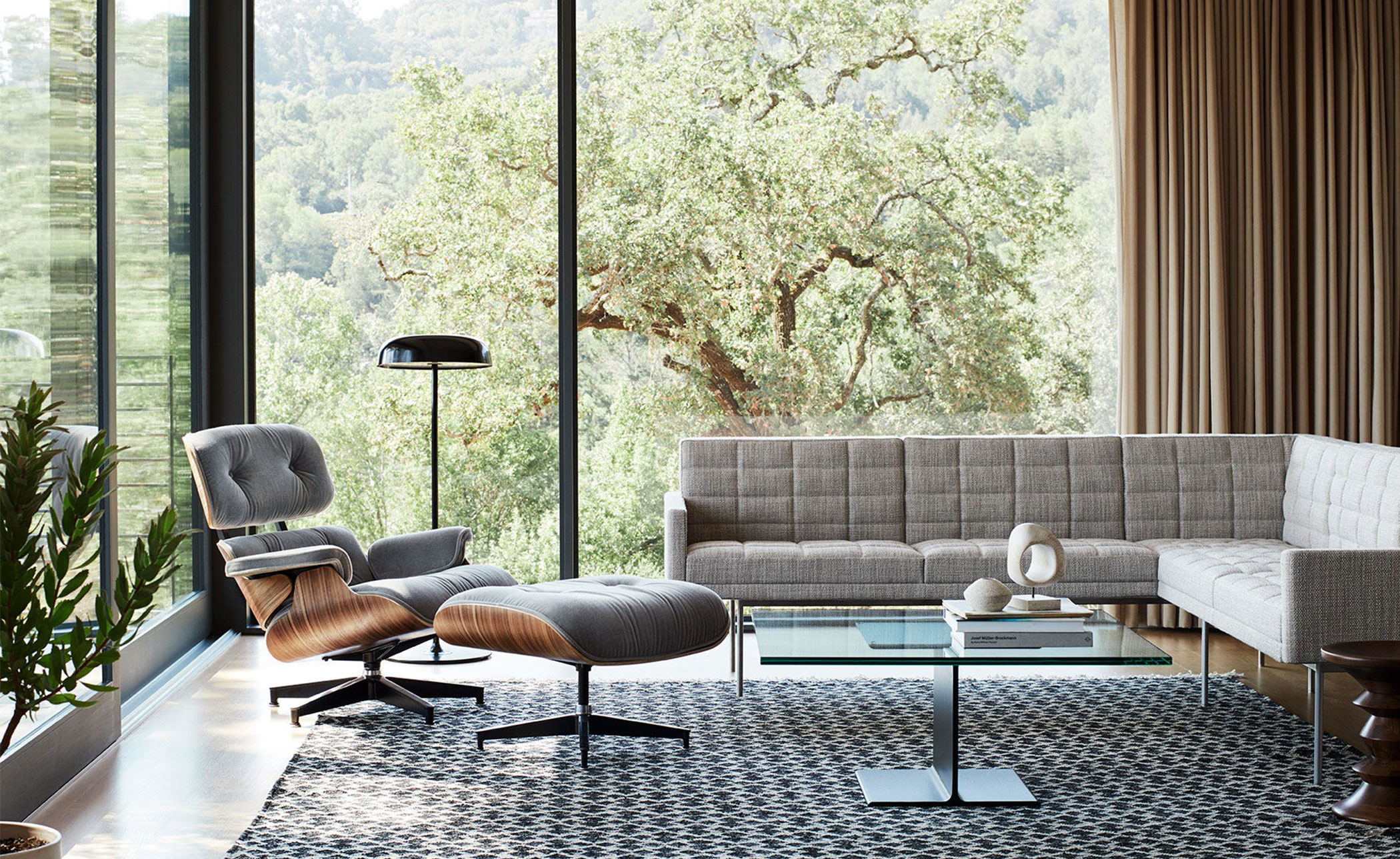
The Eames Lounge Chair and Ottoman, introduced in 1956, was unlike anything on the market—and more than six decades later, nothing has equaled it. The Eameses' modern reinterpretation of a nineteenth-century club chair has become one of the most significant furniture designs of the twentieth century, instantly recognizable and enduringly fresh. Designed by Charles and Ray Eames and made of molded plywood and leather, it was the first chair the pair designed for the high-end market, and both the chair and ottoman are now part of the permanent collection of New York's Museum of Modern Art.
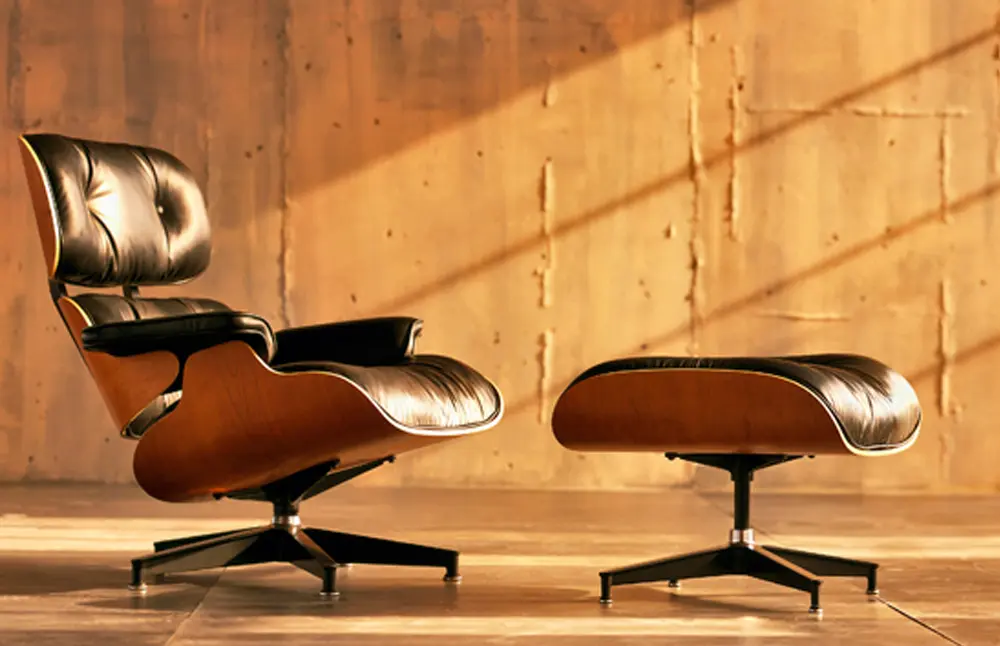
This is not an office chair in the traditional sense. It offers no height adjustment, no recline mechanism, no lumbar dial. Yet it is suited for living spaces, reception areas, and executive offices alike—a lounge piece that embodies what it really means to relax, born from the designers' desire to create a chair with "the warm, receptive look of a well-used first baseman's mitt." In continuous production since Herman Miller introduced it in 1956, the chair has been explored and celebrated by Eames Demetrios and Llisa Demetrios, grandchildren of Charles and Ray Eames.
At a glance
Brand | Herman Miller |
|---|---|
Designers | Charles & Ray Eames |
Year introduced | 1956 |
Model numbers | 670 (chair), 671 (ottoman) |
Shell materials | 7-ply molded plywood with premium veneer (walnut, santos palisander, cherry, white oak, white ash, ebony) |
Upholstery options | Leather, mohair, fabric, bamboo-based vegan leather (60+ color/material choices) |
Base | Die-cast aluminum, 360° swivel |
Key mechanisms | Rubber shock mounts (allow independent shell flex); fixed recline angle (~15°); no adjustable mechanisms |
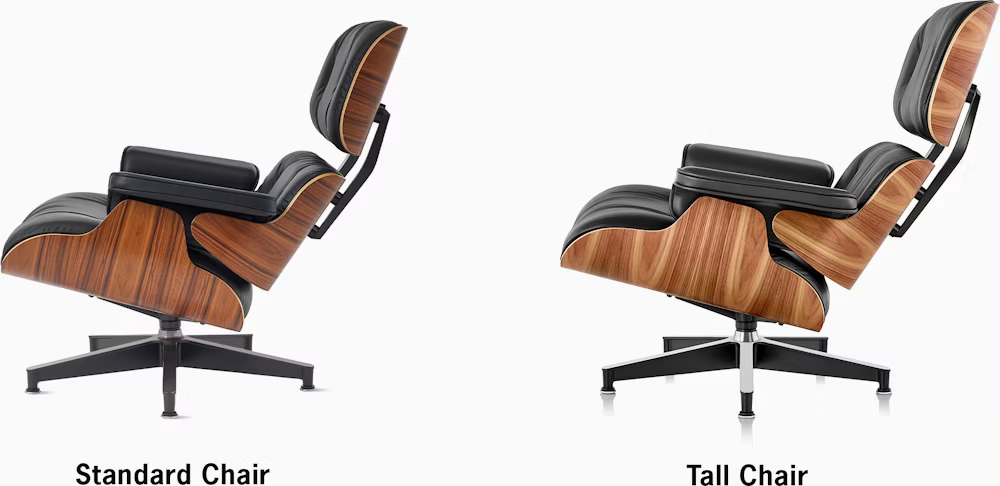
Sizes | Standard (31.5" H × 33.5" W × 32.75" D, seat height 15"), Tall (33.25" H × 33.5" W × 34.5" D, seat height 15.25") |
Weight capacity | Not publicly specified by Herman Miller; replicas commonly cite 300–330 lb |
Warranty (Herman Miller) | Lounge seating limited warranty (varies by component; consult dealer for specifics) |
Certifications | LEVEL (BIFMA), Indoor Advantage Gold (GREENGUARD) |
Manufacture | Hand-assembled in Michigan, USA (Herman Miller); Vitra in Europe |
Price tier (2026, chair + ottoman) | Premium / Luxury (~$5,995–$9,000+ depending on finish and upholstery) |
The brand & its philosophy
For more than 100 years, Herman Miller has provided solutions that stand the test of time, offering products and resources designed to inspire the best in people. Founded in Zeeland, Michigan in 1905, the company transformed from a traditional furniture maker into a modernist powerhouse in the 1940s and '50s under the creative direction of George Nelson, who recruited Charles and Ray Eames, Alexander Girard, and Isamu Noguchi to build a legendary collection.
The primary need of the human being was an essential component of every Eames design; the Eameses believed a design to be successful when it benefited the greatest number of people. Through their furniture, corporate projects, World's Fair displays, and the aesthetics of their own California Case Study home, the Eameses exemplified modern living in postwar America, and the Eames Lounge and Ottoman, introduced by Herman Miller in 1956, remains a touchstone of American style. Herman Miller's commitment to quality, environmental stewardship, and design integrity has kept the Lounge Chair in continuous production for seventy years—a manufacturing run virtually unmatched in the furniture industry.
The designer and the design story
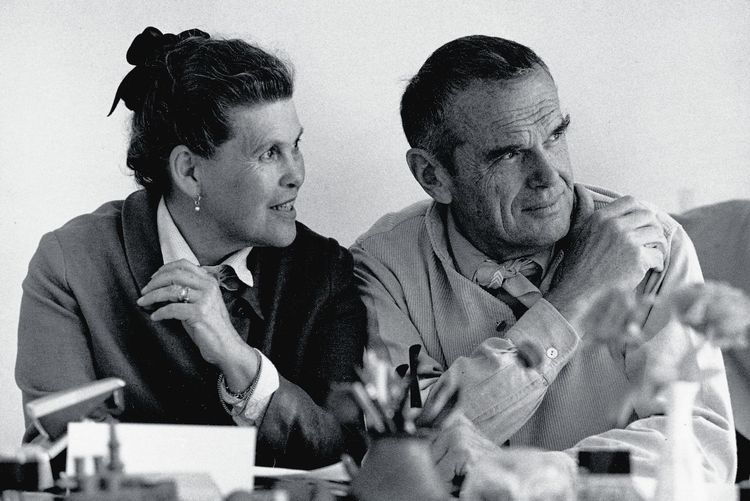
Charles Eames Jr. and Ray-Bernice Eames were an American married couple of industrial designers who made significant historical contributions to the development of modern architecture and furniture through the work of the Eames Office; they also worked in the fields of industrial and graphic design, fine art, and film, with Charles as the public face but Ray and Charles working together as creative partners alongside a diverse creative staff. Charles met Ray Kaiser at the Cranbrook Academy of Art in 1940, where Charles had arrived on an industrial design fellowship recommended by Eliel Saarinen but soon became an instructor.
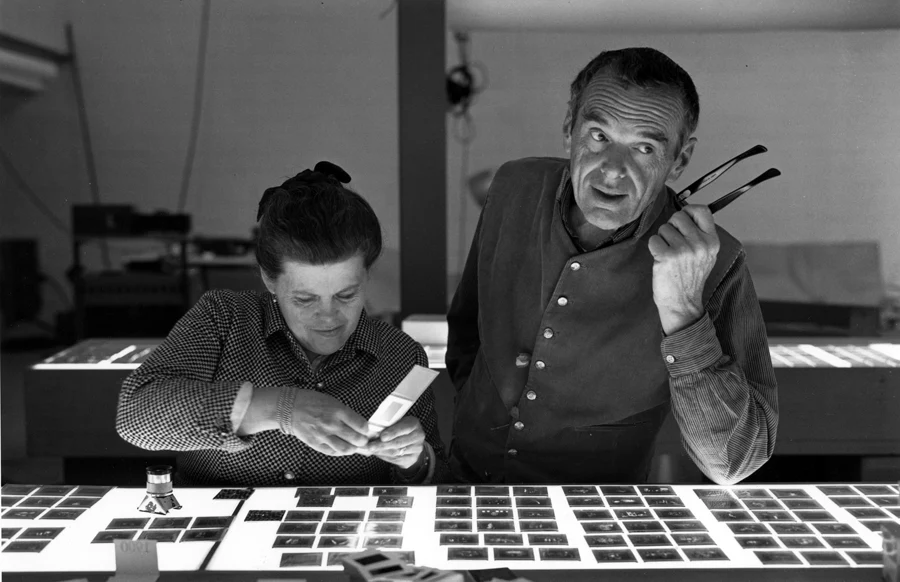
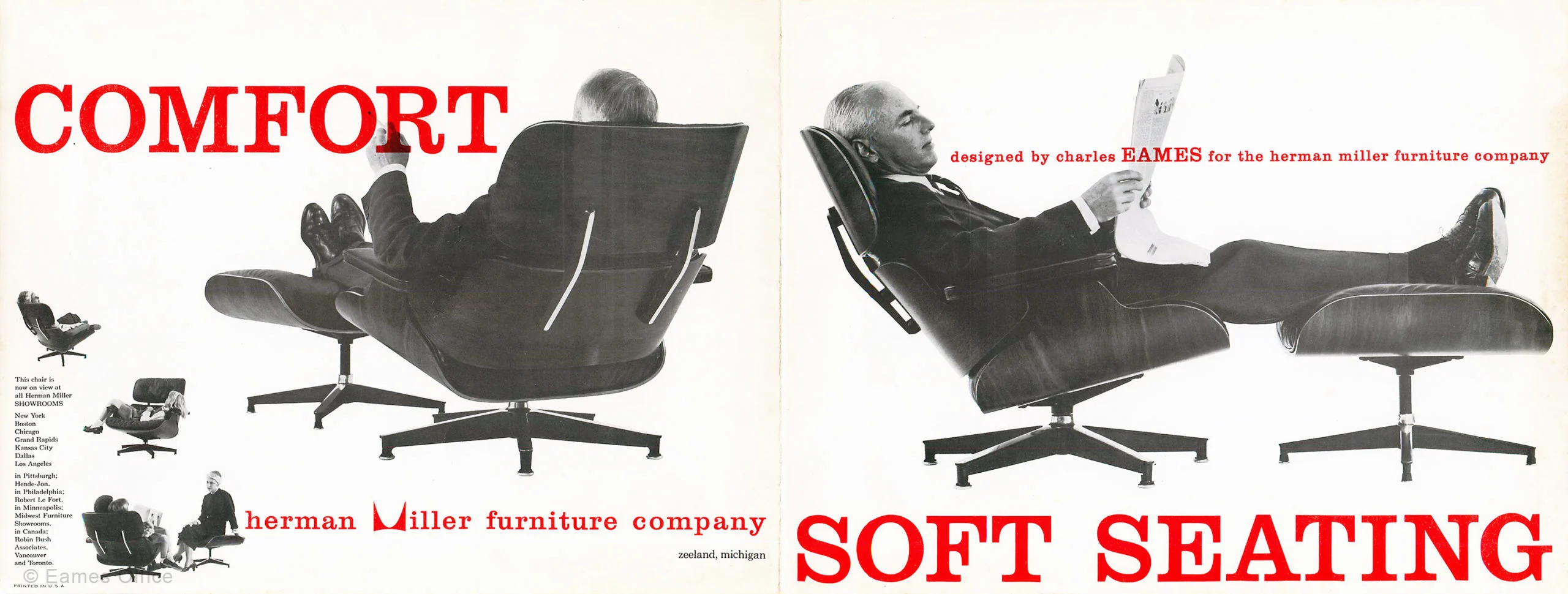
The Eames Lounge Chair and Ottoman have their origin in Charles and Ray's investigations into molding plywood and a desire to improve upon a familiar fixture in many living rooms: the lounge chair. Citing the English club chair as inspiration, Charles said he sought to design a modern version of that chair, one that had "the warm receptive look of a well-used first baseman's mitt." It was the first chair the Eameses designed for the high-end market; though the Eames Lounge Chair later came to be considered an icon of modern design, when it was first made, Ray Eames remarked in a letter to Charles that the chair looked "comfortable and un-designy."
The Eames Lounge Chair and Ottoman debuted on national television in 1956 when Charles and Ray Eames appeared on the NBC television network Home show hosted by Arlene Francis, and stardom ensued for both design and designers. The first lounge chair and ottoman, produced in 1956, was a birthday gift for friend Billy Wilder, the Academy Award-winning film director. Part of the permanent collections at New York's MoMA and the Art Institute of Chicago, the chair and ottoman have been the subject of documentary films and books and were the sole subject of a museum show at the Museum of Arts & Design in New York.
Design language & aesthetics
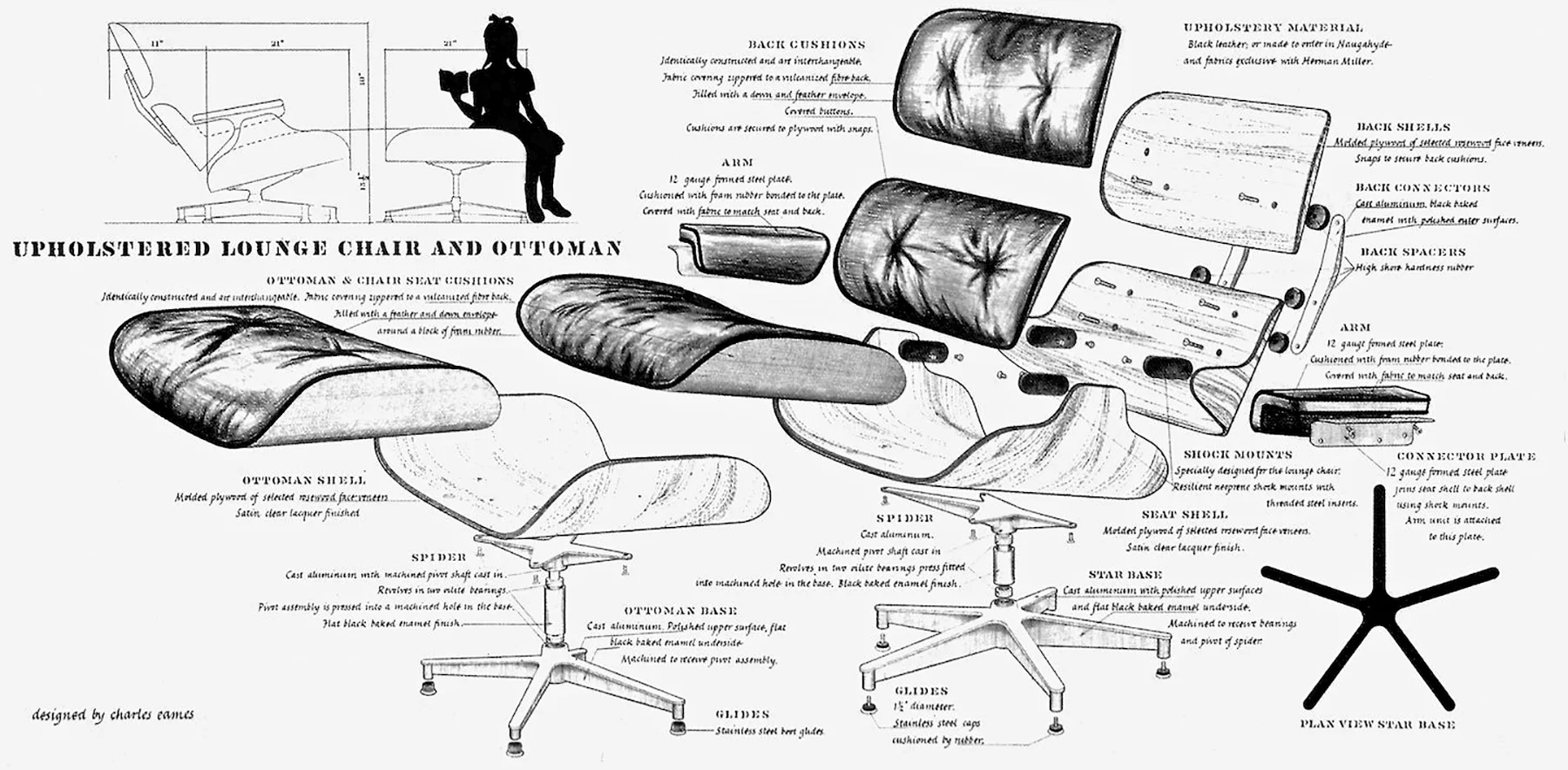
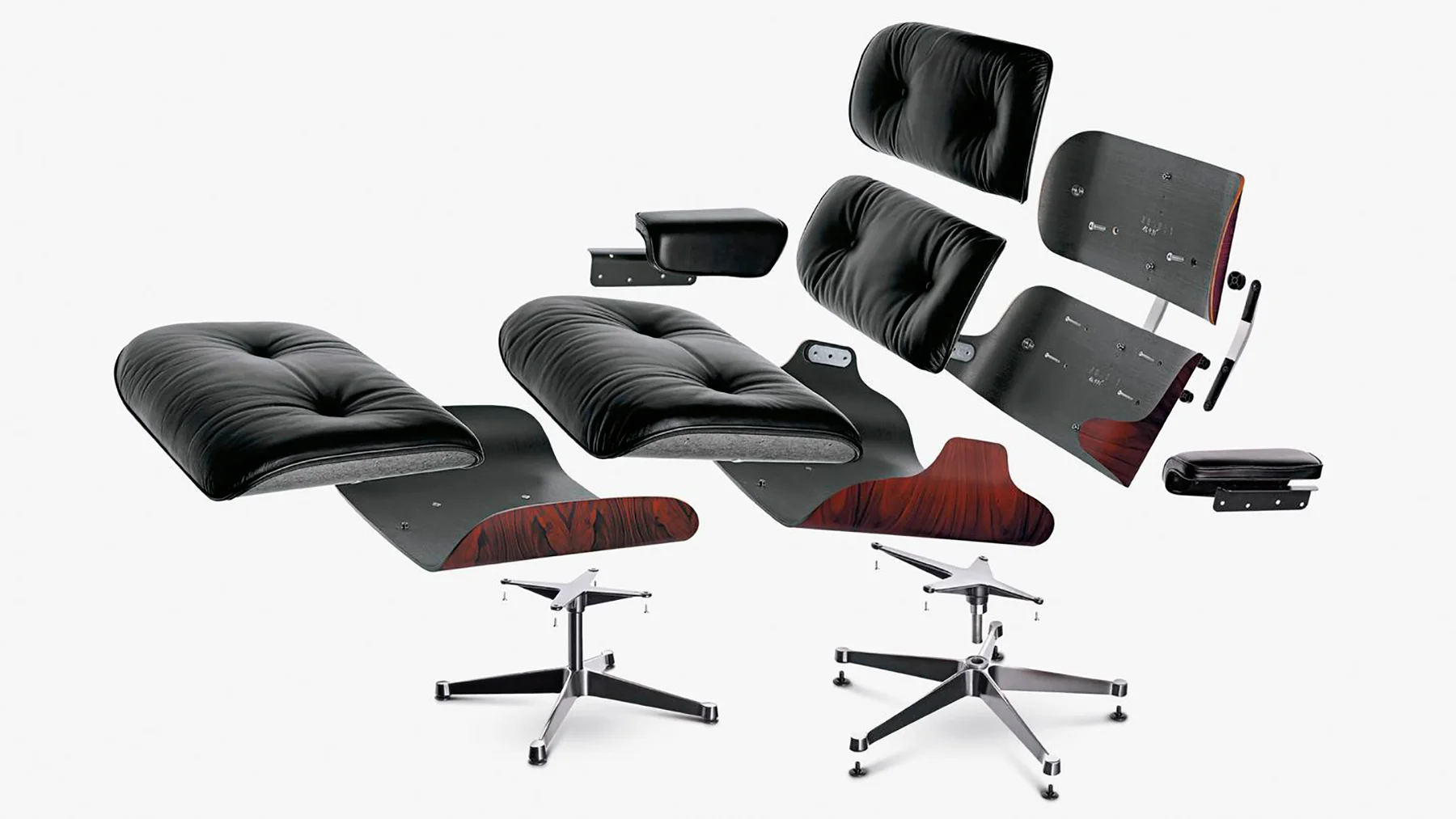
The design of the Eames Lounge Chair and Ottoman is so recognizable that its configuration is a registered trademark, and that form and the materials used to create the set are an integral part of what it delivers. The chair is composed of three curved plywood shells—headrest, backrest, and seat—each upholstered with button-tufted leather cushions that snap into place. The headrest, lumbar rest, and seat are all separate shells filled with plush leather-upholstered cushions; though the Eames lounger is simple in its makeup, it's the overall quality of its construction and attention to detail that lends the chair its unwavering prestige.
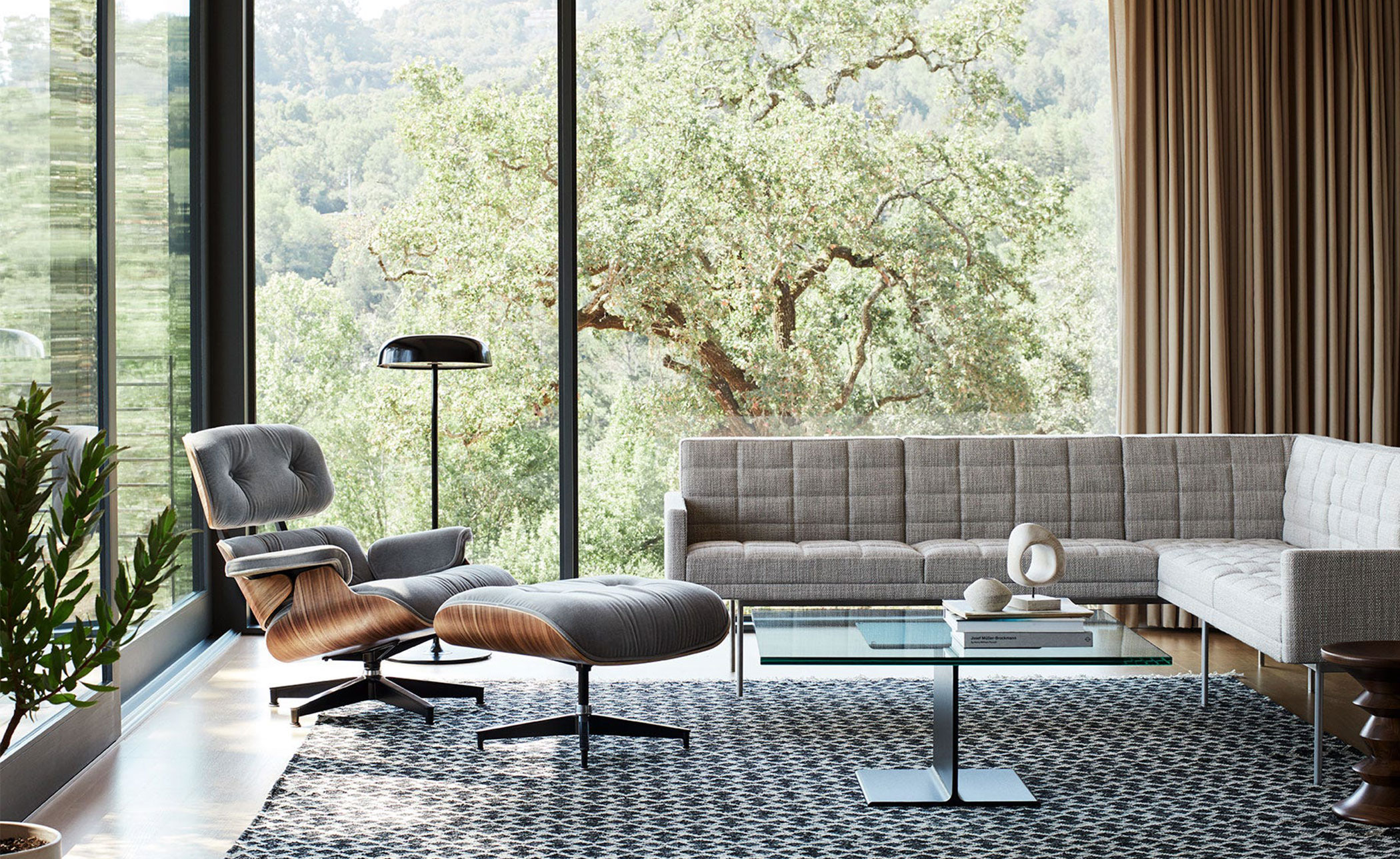
Today, the chair and ottoman are available in two sizes, a variety of veneers, and a range of upholstery options, and regardless of which options you choose, the same high level of quality and workmanship is guaranteed. An oiled finish is available for walnut and santos palisander veneers, closely matching the look and feel of the finish used on the original rosewood chair and requiring periodic hand oiling, while you can also choose the standard, high-performance lacquered plywood shell in all wood veneers—the lacquered finish requires nothing more than dusting. The result is a visual language that feels both sculptural and inviting, luxurious without ostentation.
Ergonomics & how it supports the body
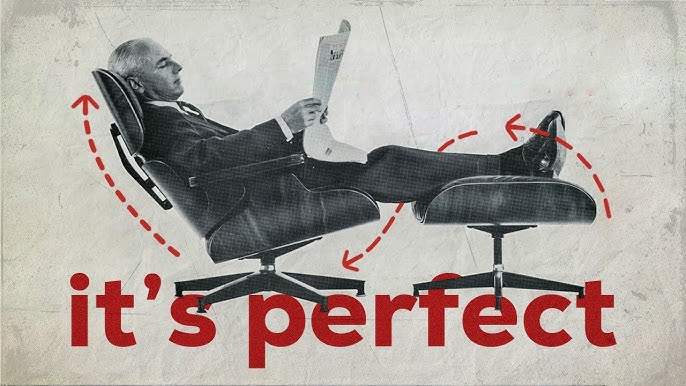
The fixed angle of the Eames Lounge Chair is not a limitation—it's a masterstroke of ergonomics. The Eameses spent five years perfecting the exact pitch between the seat, back, and headrest, engineering the chair to place you into a position that is both alert and deeply relaxed—what ergonomists now refer to as "passive support." The seat of the Lounge Chair has a permanent tilt; this angle supports your chest, so you'll be more comfortable while reading, watching TV, and conversing, taking weight off your lower spine and distributing it to the back of the chair.
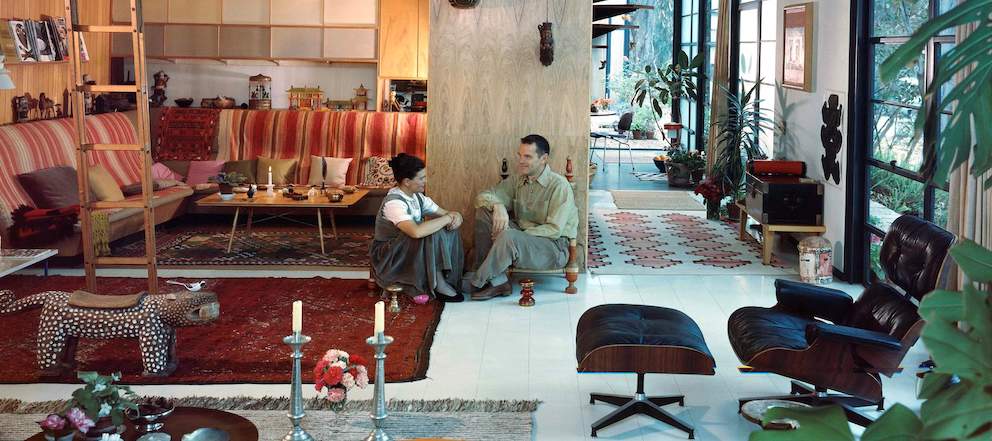
The Eames lounge chair's signature innovation is the patented "shock mounts"—arguably the most critical contributing factors toward the chair's legendary comfort—heavy rubber washers with nuts inside that are glued to the backrest of the chair and screwed into the lumbar support, isolating various pieces of the chair and allowing it to bend and flex slightly with the body (not unlike a rocking chair); this, combined with the signature Eames chair base, a five-legged, cast aluminum pedestal, creates a relaxing, weightless experience. The ottoman provides a health benefit: besides being a comfortable place to rest your feet, it helps restore normal blood circulation after a work day of constant sitting or standing.
Key adjustments & mechanisms
The Eames Lounge Chair offers no adjustments in the contemporary task-chair sense—no levers, no knobs, no pneumatic cylinder. It does not lean back, it does not ratchet, it does not lock or unlock; there is no lever, no mechanism, no gears—if your Eames Lounge Chair reclines, it isn't real. The Eames Lounge Chair does not recline; instead, it offers perfect pitch for a relaxed posture, featuring molded wood shells that cradle the body, and it's set on a versatile swivel base for ease of movement.
Though the chair doesn't recline, it does flex thanks to the rubber shock mounts that connect the back shell to the lumbar shell and the lumbar shell to the seat; these shock mounts allow the back to move slightly, creating a subtle sense of give—almost like a gentle breathing motion—and that tiny bit of flex creates the illusion of a reclining experience without the mechanics of a recliner. The Eames Chair swivels 360 degrees for ease of movement. The cushions are removable and reversible, but the chair itself is engineered around a single, perfected angle of repose.
Materials & build quality
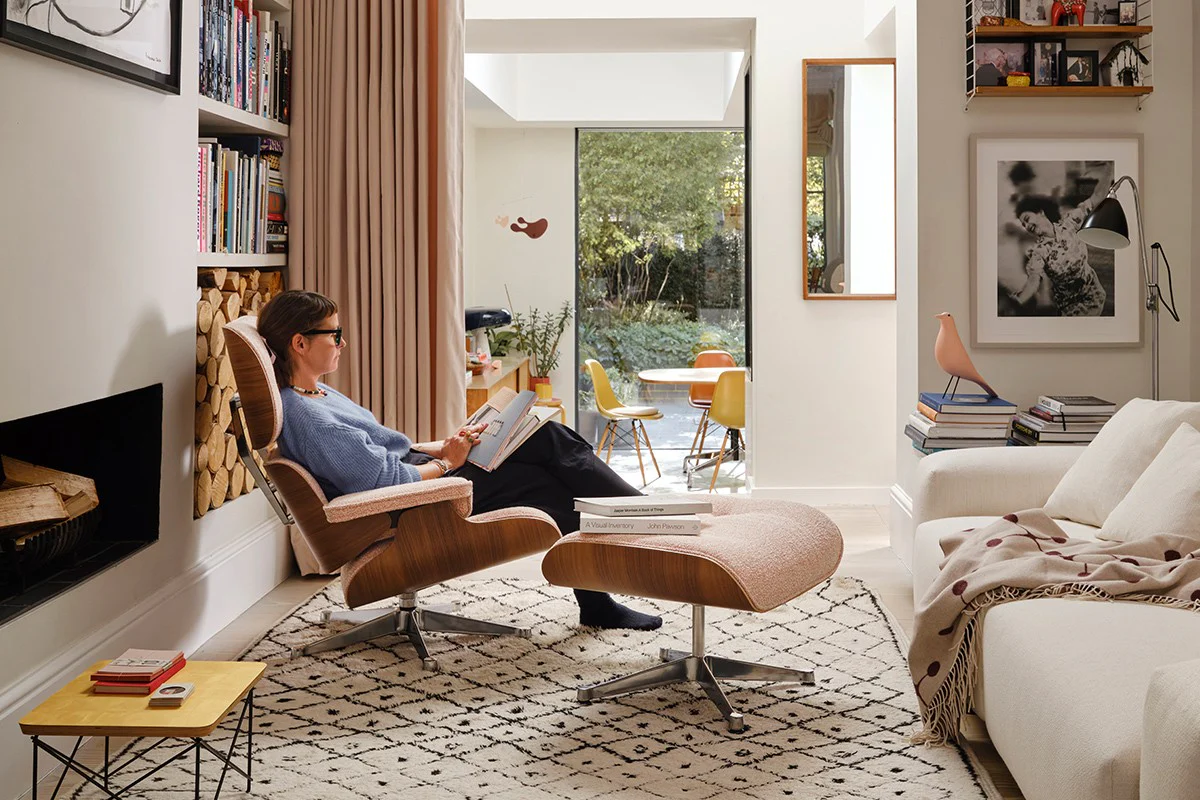
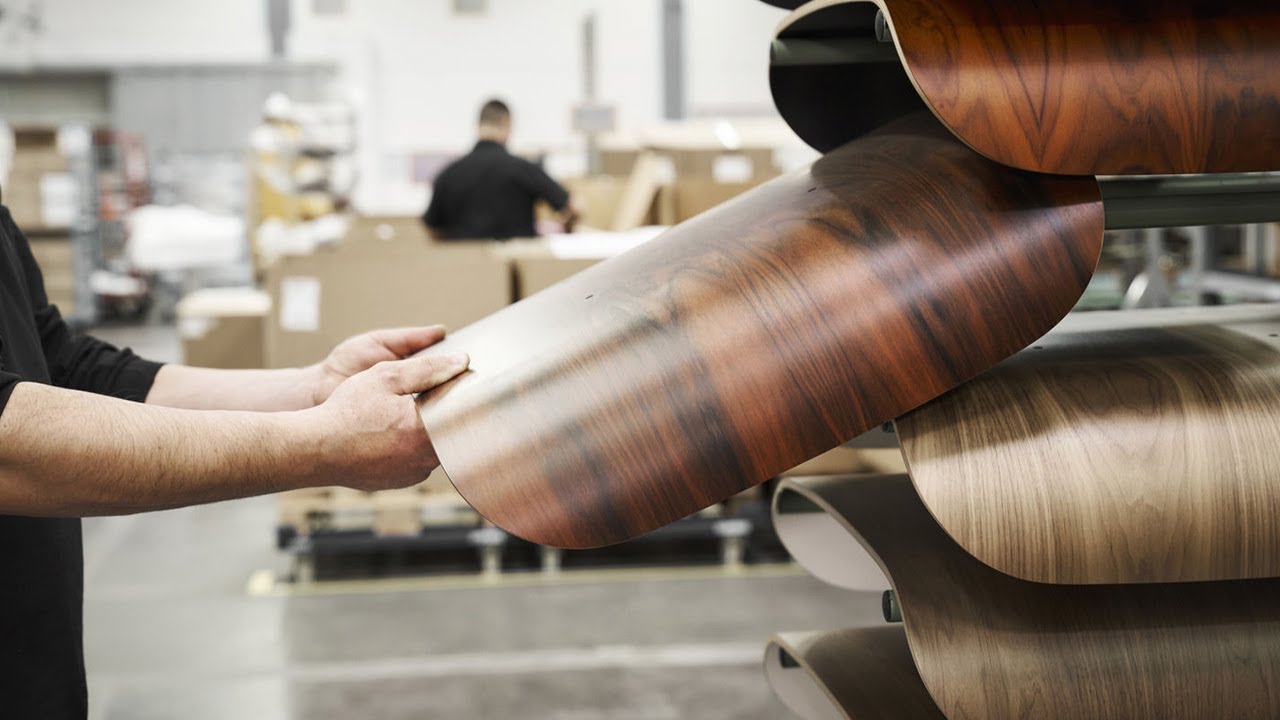
Both the chair and ottoman are hand-assembled with great attention paid to the details; shells are 7-ply veneers, cushions are individually upholstered and replaceable, the back braces and bases—of both the chair and ottoman—are die-cast aluminum, and the chair base has a built-in swivel mechanism. Beginning in 1956 and running through the very early 1990s, the shells were made up of five thin layers of plywood covered by a veneer of Brazilian rosewood; the use of Brazilian rosewood was discontinued in the early 1990s, and current production since then consists of seven layers of plywood covered by finishing veneers of cherry, walnut, palisander rosewood (a sustainably grown wood with similar grain patterns to the original Brazilian versions), and other finishes.
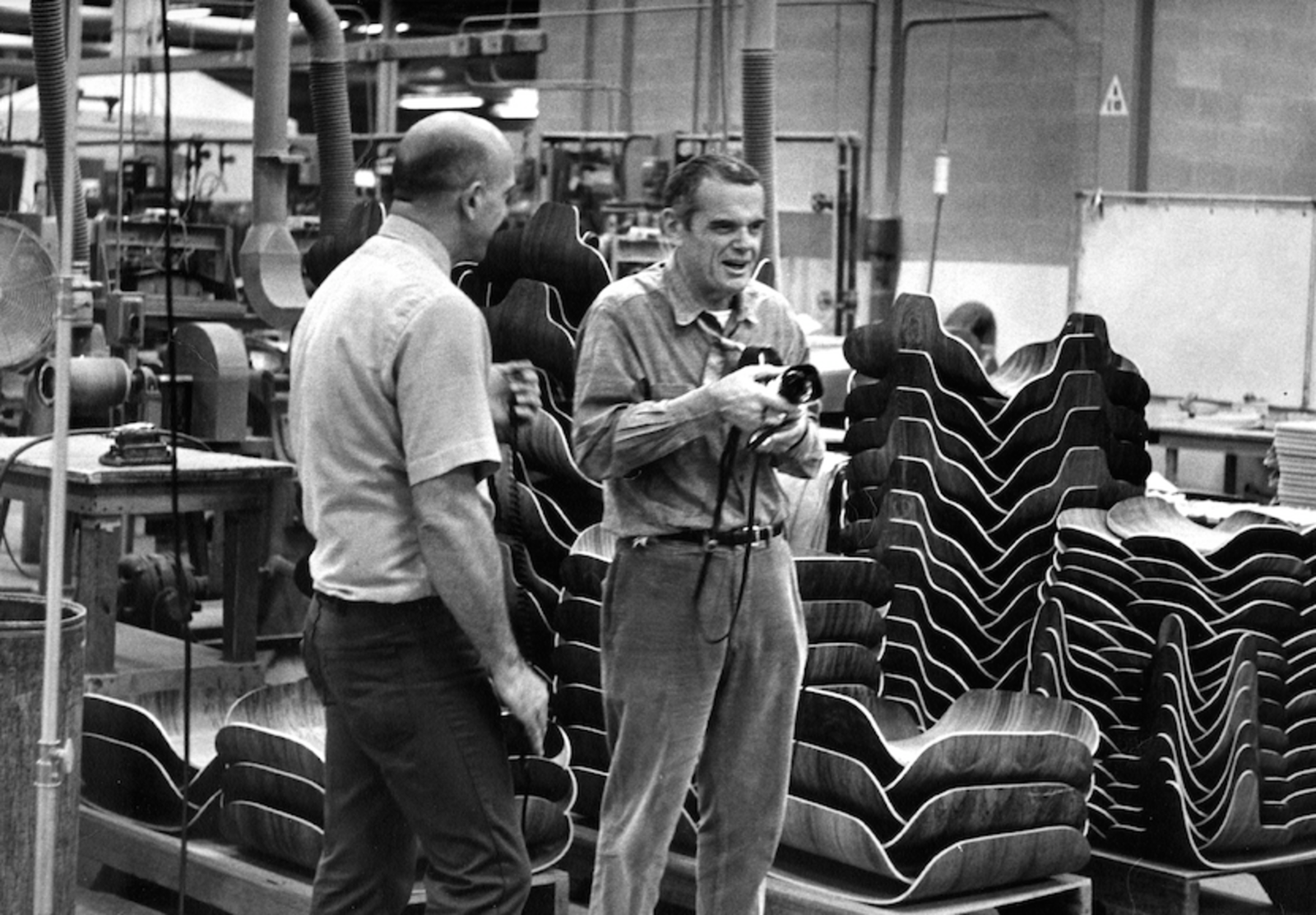
The comfort and support built into the Eames Lounge Chair and Ottoman help explain their enduring popularity; a dynamic blend of hand-craftsmanship and mass production techniques makes this possible, and the cushions will not flatten or clump over time. As Charles Eames described them, "The leather cushions do have built-in wrinkles to start with, but that is a clue that spells comfort to come, like the warm, receptive look of a well-used first baseman's mitt." Available in standard and tall heights, the Eames Chair and Ottoman come in seven wood finishes and more than 60 shades of leather and fabric upholstery. In keeping with Herman Miller's longstanding focus on environmental stewardship, bamboo has been added as an upholstery option for the lounge and ottoman.
Sitting experience — what it actually feels like day to day
The angle of the seat is perfectly reclined, the cushions are soft but still offer just the right amount of support, and the chair is mounted to a swivel base which also allows for a bit of movement. As Charles Eames famously described, "The leather cushions do have built-in wrinkles to start with, but that is a clue that spells comfort to come, like the warm, receptive look of a well-used first baseman's mitt." Jennifer Nield, vice president of lifestyle product at MillerKnoll, notes "This chair is designed to really embrace you and will get even more comfortable over time."
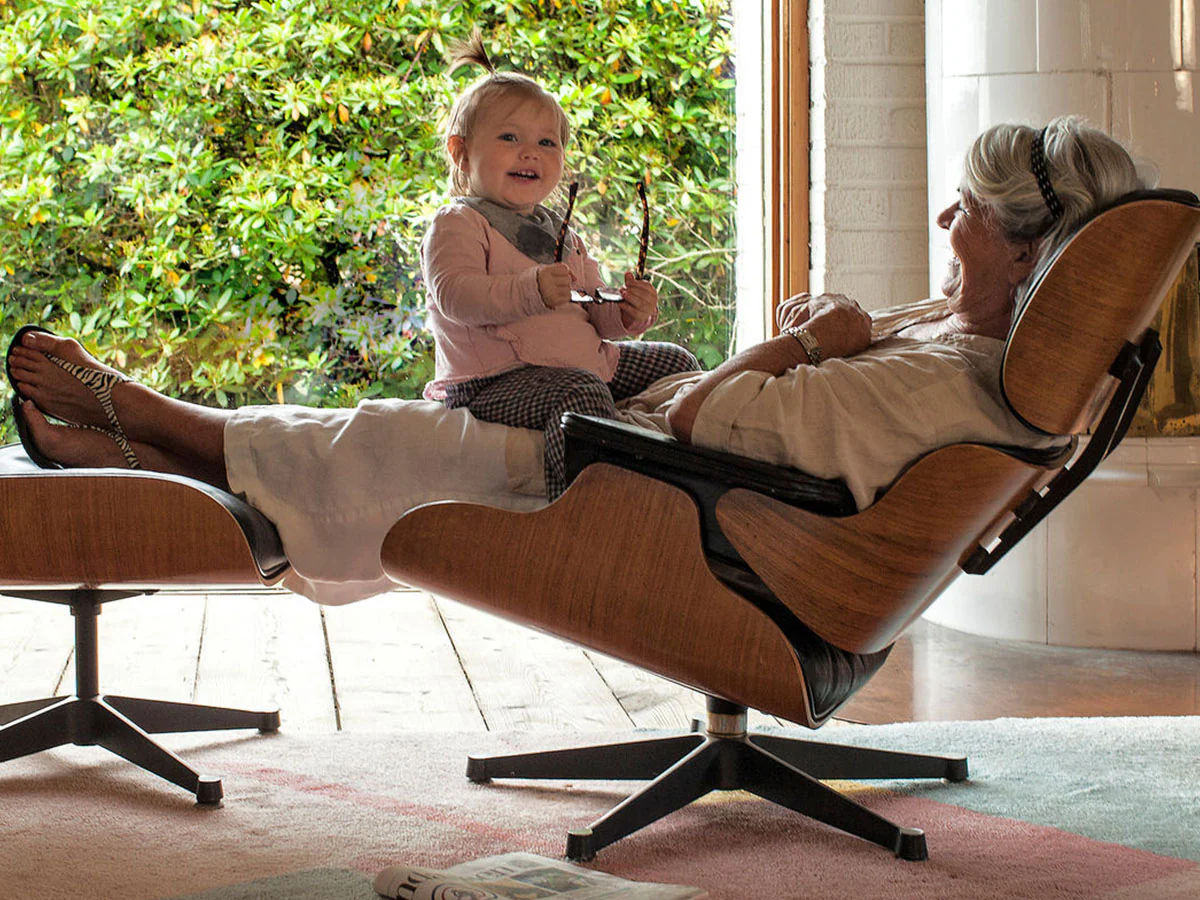
Real-world owner feedback is overwhelmingly positive. Reviewers describe the chair as "so much more than a piece of furniture, it is a work of art," noting "The wood is so extraordinary and the leather absolutely smooth and well crafted. The design timeless and the construction flawless." Owners emphasize "this is a chair you buy for life. It is meant to be passed down to the next generation." The chair does not encourage forward-leaning work postures—it's built for reading, conversation, and true relaxation. If you spend eight hours a day in Zoom meetings, this is not your task chair; if you want a sanctuary at the end of those meetings, it is unmatched.
Who it's for (and who should skip it)
Best for:
Design collectors and mid-century enthusiasts who want an authentic icon with documented provenance and museum-level craftsmanship.
Home-office executives who already own a task chair and need a dedicated lounge zone for reading, calls, or end-of-day decompression.
Living-room loungers seeking a statement piece that combines visual presence with genuine, long-session comfort.
Tall users willing to select the extended-height model, which reviewers note makes a significant difference—taller than 5'11", you'll want to test-drive both sizes.
Long-term thinkers who view furniture as heirloom investment; in present dollars, the chairs sell for about the same as they once cost in 1956, they don't depreciate the way most furniture does, and many are handed down from generation to generation as beloved heirlooms.

Skip it if:
You need height adjustment, lumbar dials, or active recline for task work—this chair offers none of that.
Your budget tops out below $5,000 and you're not willing to explore well-researched replicas.
You're shorter than 5'6" and find the standard size too deep; the fixed pitch may not align with your proportions.
You want a chair that disappears into the background—the Lounge demands visual real estate and won't blend quietly into minimalist Scandinavian neutrals.
Comparisons with key rivals
Chair | Price tier (2026) | Form & adjustability | Standout strength |
|---|---|---|---|
Eames Lounge Chair & Ottoman | ~$6,000–$9,000 | Molded plywood shells, leather/fabric, fixed angle, 360° swivel; no height/recline adjustment | Museum-pedigree design, hand-assembled in Michigan, unmatched cultural cachet, shock-mount flex system |
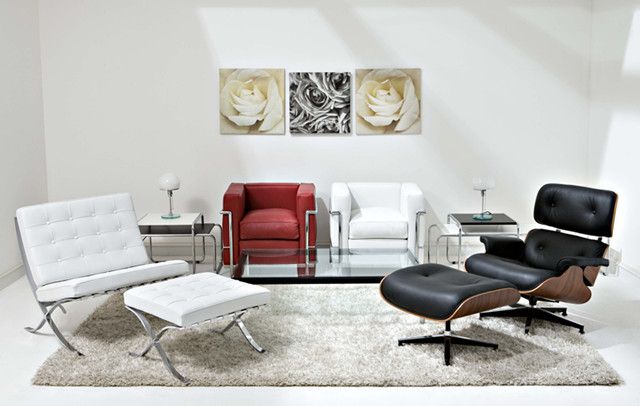
Knoll Barcelona Chair (Mies van der Rohe, 1929) | ~$7,000–$9,500 | Chrome X-frame, tufted leather cushions, no swivel, upright lounge posture | Synthesis of van der Rohe's highly disciplined architecture; chrome-plated steel bars and leather straps, an intersection replicating the simple X-shape of ancient Egyptian folding stools and 19th-century neoclassical seats. More formal, sculptural presence. |
Knoll Womb Chair (Eero Saarinen, 1948) | ~$4,500–$6,500 | Molded fiberglass shell, upholstered, tilted back, no ottoman | Enveloping "hug-me" form, lighter visual footprint, easier to move; better for smaller spaces or those who don't need the ottoman |
Herman Miller Striad Lounge (Markus Jehs & Jürgen Laub, 2016) | ~$3,500–$5,000 | Molded foam over frame, fabric/leather, low profile, optional ottoman | Contemporary alternative with softer, more casual lines; easier price point, modern aesthetic without mid-century nostalgia |
The purpose difference between the Eames and the Barcelona matters: the Eames lounge chair and ottoman was designed for personal comfort, deep recline, warm rosewood shells, and leather that pulls you in, while the Barcelona Chair was designed for ceremony and presence—one belongs beside a reading lamp in a bay-windowed flat, the other belongs in a reception room or an architect's office.
Sizing, fit & configuration options
The Eames Lounge Chair comes in standard and tall sizes; since the chair was developed in 1956, the average height of people worldwide has increased approximately one inch, so Herman Miller and the Eames Office, still run by the Eames family, developed the taller size. The Eames Lounge Chair (standard) is 32.75" wide, 32.75" deep, with a back height of 31.5" and a seat height of 15"; the accompanying ottoman has a width of 26", depth of 21.5", and height of 17.25". The tall version of the lounge chair adds 1.75" to the overall height making it 33.25" tall, and it also adds half an inch to the seat height of the chair.
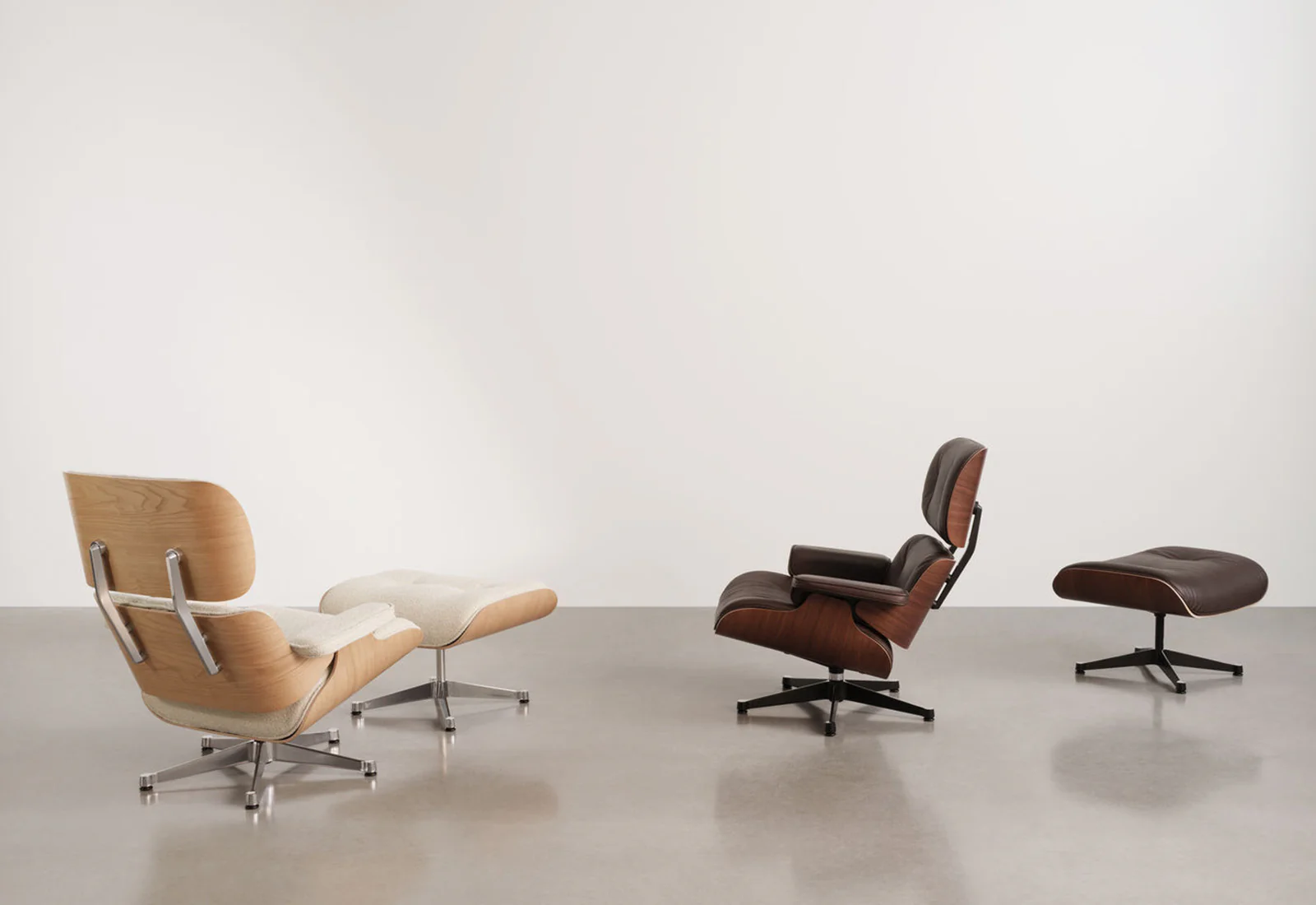
Available in standard and tall heights, the Eames Chair and Ottoman come in seven wood finishes and more than 60 shades of leather and fabric upholstery. Wood options include walnut, santos palisander, cherry, white oak, white ash, and ebony; upholstery ranges from classic Italian full-grain leathers to mohair, checker fabrics, and bamboo-based vegan leather. Each configuration is made to order, with lead times typically 4–14 weeks depending on finish and retailer. Customization is part of the allure—and part of the wait.
Sustainability & certifications
The chair is LEVEL Certified and Indoor Advantage Certified; LEVEL by BIFMA is an evaluation and certification system for environmentally preferable and socially responsible office furniture with three performance tiers (LEVEL 1, 2, and 3)—the higher the number, the more criteria considered and met across materials, environmental impact, human health, and social responsibility—and Indoor Advantage Gold certification is SCS Global Services' highest level of indoor air quality performance for furniture, assuring that furniture products support a healthy indoor environment by meeting strict chemical emission limits for volatile organic compounds (VOCs).
Herman Miller introduced a new milestone in the rich Eames Lounge Chair history with the introduction of an Advanced Plant-Based Material—bamboo-based upholstery that helps reduce the materials carbon footprint of the chair by up to 35% while still providing superior comfort and durability. The use of Brazilian rosewood was discontinued in the early 1990s, and current production uses seven layers of plywood covered by finishing veneers of cherry, walnut, palisander rosewood (a sustainably grown wood), and other finishes. Herman Miller sources wood primarily from sustainably managed forests in the American Midwest and South, a shift driven by environmental awareness and third-party certification standards.

Maintenance, durability & warranty
Like all Eames furniture, the Eames Lounge Chair and Ottoman are expertly crafted, designed to last for decades; when properly maintained, the Eames Lounge Chair will hold its value for generations to come, and owners should follow the Care and Maintenance Guide for cleaning the cushions and periodically polishing the veneer shells. For leather cushions, use a soft cloth to wash periodically with lukewarm water and a mild soap (Ivory or Castile Bar Soap), wipe with another clean, damp cloth, buff dry with a soft cotton terry towel, and clean the entire surface of the leather—do not spot clean; do not use saddle soaps or oils as these products contain solvents that will break down the oils used in tanning the leather, harming its stain resistant finish.
Many Herman Miller products are covered by a 12-year warranty that includes parts and labor—it's Herman Miller's promise to stand behind the quality of their products. The Eames Lounge Chair and Ottoman carries a 3-year warranty, while other Eames chairs (such as the Aluminum Group) have 12-year coverage after January 1999. Warranty claims require proof of purchase and photos; Herman Miller dealers coordinate repair or replacement. Cushions are individually upholstered and replaceable. The chair's modular construction means that worn components can be swapped rather than discarded—a durability feature that underpins its heirloom status.
Pricing, value & where it sits in the market
Starting at $5,995 for configurations like the White Oak shell, Herman Miller has designed the chair to fit a range of budgets—without forsaking the quality they aspire to. In practice, the most popular configurations (walnut or palisander with classic black leather) run $7,000–$8,500 for the chair and ottoman set; premium leathers, tall sizing, and oiled finishes push the upper range toward $9,000+. The most recognizable configuration of the chair—featuring a palisander rosewood plywood shell with black leather upholstery—retails for $7,895, and there are cheaper configurations available, but all of them are going to cost several times more than what the average person is willing or able to spend on a chair.
The Eames Lounge Chair and Ottoman are not inexpensive, but they do provide good value, and they would be much more expensive if the design wasn't as well considered as it is in terms of standardized parts; in present dollars, the chairs sell for about the same as they once cost in 1956, and these don't depreciate the way most furniture does—many are handed down from generation to generation as beloved heirlooms. Vintage examples in good condition often sell for $3,000–$6,000 on the secondary market; pristine first-generation rosewood chairs from the late 1950s can command $10,000 or more at auction. This is furniture as asset, not disposable commodity.
Verdict — the bottom line
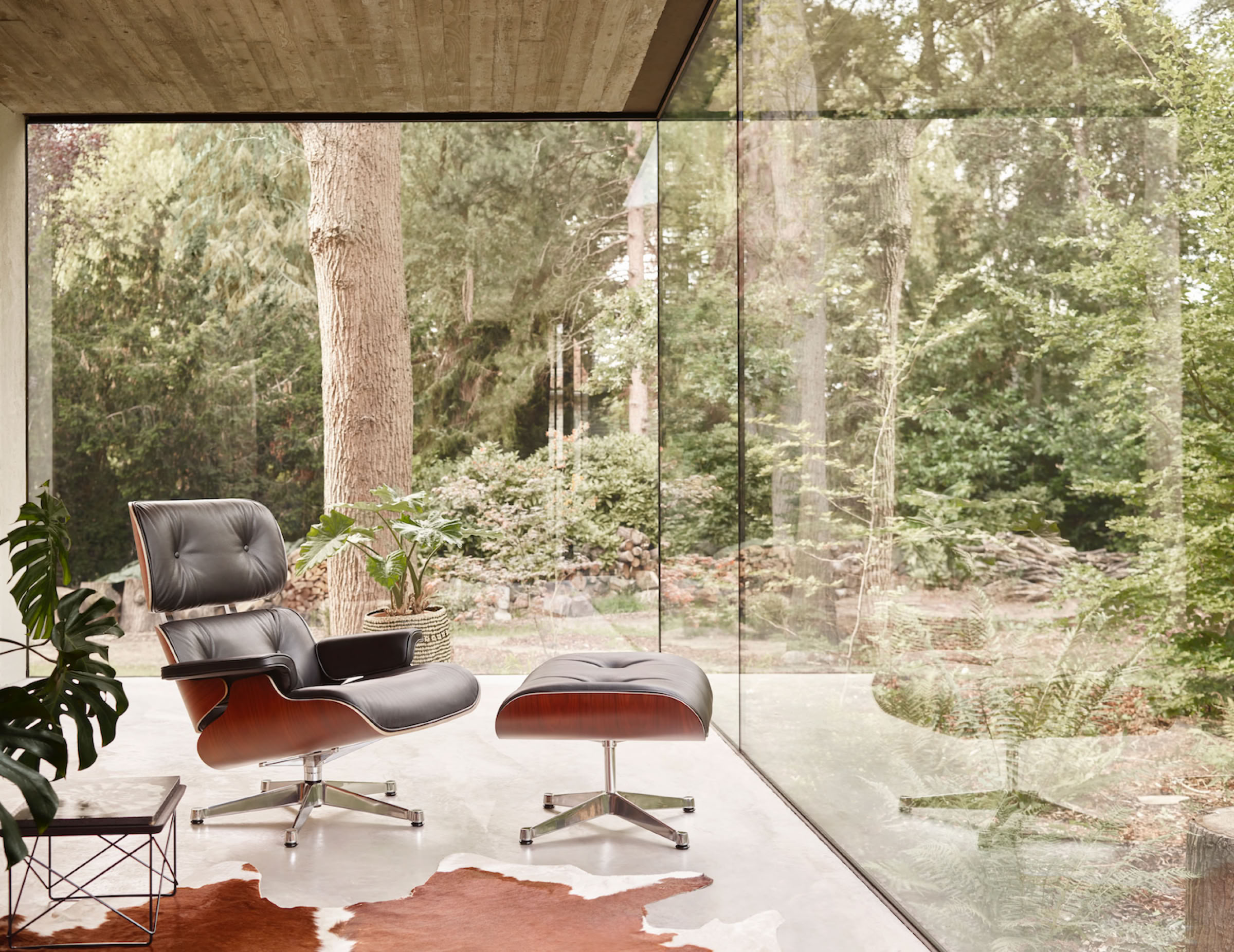
The Eames Lounge Chair and Ottoman is not the most ergonomic office chair you can buy, nor the most adjustable, nor even the most comfortable in a pure function-over-form sense. What it is is the most culturally significant lounge chair of the twentieth century—a piece that marries engineering rigor, material honesty, and aesthetic grace in a way that has not been replicated or surpassed in seventy years.
The Eames Lounge Chair is quite possibly unrivaled on all levels, fusing industry-leading ergonomic comfort with beautiful good looks; the design from start to finish was a painstaking progress of finding the ideal position, perfecting the angles which provide that all-over body comfort, and adding sumptuous and inviting leather leaves you with a design that is coveted the world over. It does not recline, it does not adjust, and it costs as much as a used car. Yet it delivers something almost no task chair can: a fixed, perfected posture of repose that improves with age, backed by hand-assembly in Michigan, museum provenance, and a manufacturing legacy unbroken since 1956.
"The warm, receptive look of a well-used first baseman's mitt."
If you need a task chair, buy an Aeron or an Embody. If you need a lounge chair that will anchor a room, age gracefully, hold its value, and become a piece your grandchildren recognize—this is it. The Eames Lounge Chair is not for everyone. But for those it fits—spatially, financially, aesthetically—it remains unequaled.