KI Kiaura Collection
A gravity-powered chair that redefines Human Performance Seating
Overview

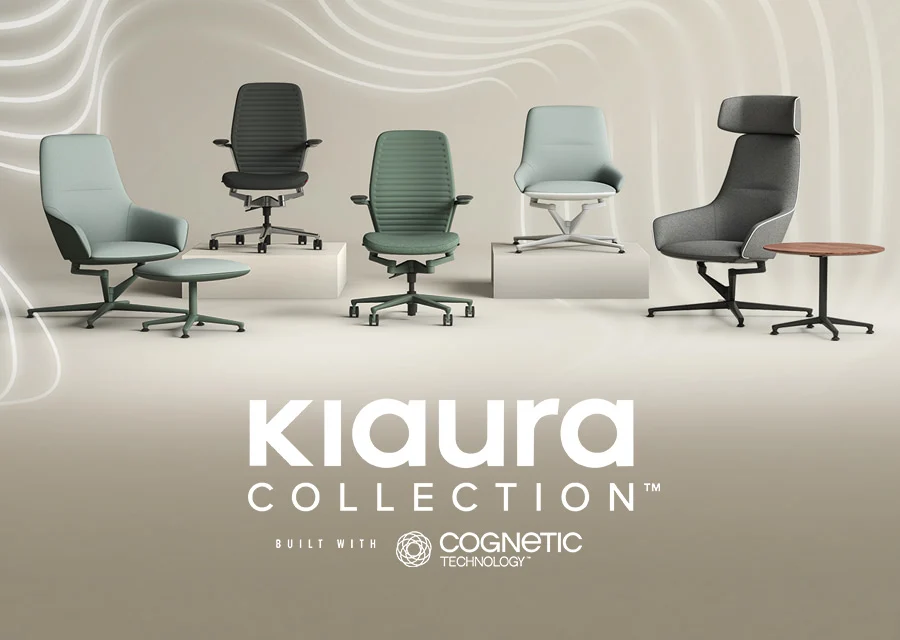
The Kiaura Collection represents contract furniture manufacturer KI's most significant seating innovation to date and introduces what the company defines as a new category: Human Performance Seating. Cognetic Technology, invented by Aaron DeJule, is a gravity-responsive, multi-axis motion system that continuously responds to subtle shifts in the body, creating a seated experience that feels fluid, intuitive, and restorative.
Debuting at the KI Inspiration Center during Design Days in Chicago in June 2026 , this is not an incremental update to conventional task-chair ergonomics—it's a fundamental rethink. Designed and invented by Aaron DeJule, the Kiaura Collection built with Cognetic Technology challenges the assumption that sitting itself should still be relatively static. Instead, it allows the chair to move with you in every direction, powered entirely by gravity and your body's natural micro-movements.
The technology makes its first full commercial application within the Kiaura Collection, a coordinated family of task, conference, and lounge seating alongside complementary tables and ottomans. For organizations seeking a unified design language across workspaces, meeting rooms, and lounge areas, the Kiaura Collection offers architectural cohesion and a shared philosophy: that movement isn't a distraction from focus, but the foundation of human performance.
At a glance
Brand | KI |
|---|---|
Designer | Aaron DeJule |
Year launched | 2026 |
Core technology | Cognetic Technology (patented, gravity-responsive, multi-axis motion) |
Collection variants | Task seating, conference seating, lounge seating, occasional tables, ottomans |
Key adjustments (task model) | Seat height, lock/unlock motion control (task & conference); weight-activated auto-unlock (lounge) |
Materials | Advanced knit textiles, broad material palette, monochromatic & polished aluminum finishes |
Warranty | KI industry-leading warranty (typically lifetime for many components; confirm with dealer) |
Price tier | Premium contract-grade (pricing by quote through KI dealers) |
Weight capacity | Not publicly specified; standard commercial-grade expected |
Certifications | KI has 175+ products BIFMA LEVEL® certified; Kiaura certification status to be confirmed |
Awards | Best of NeoCon 2026: Best of Competition (Integrated Technology), Gold (Task, Conference, Lounge, Collections) |
The brand & its philosophy
Headquartered in Green Bay, Wisconsin, KI is a 100% employee-owned company with a dedicated presence across the US, Canada, Latin America, Europe, and Asia. Since 1941, KI has been the trusted expert in creating adaptable and forward-thinking products that empower success in education, healthcare, government, and corporate markets. As an employee-owned company, KI is in a unique position to positively impact the people and organizations who share the community it calls home.
KI's trajectory is one of patient accumulation: eight decades of contract furniture experience, a vertically integrated manufacturing operation in Green Bay, and a corporate culture rooted in collective ownership rather than quarterly earnings. KI tailors products and service solutions to the specific needs of each customer through its unique design and manufacturing philosophy. This isn't a brand chasing fashion—it's an infrastructure built on reliability, longevity, and evolutionary refinement.
With the Kiaura Collection, KI marks the beginning of a broader shift toward designing workplace experiences centered on movement, well-being, and human performance. The launch signals that KI is no longer content to merely compete in the traditional ergonomic task-chair market; it's attempting to redefine what a chair is supposed to do.
The designer and the design story
Aaron DeJule is an industrial designer and founder of DeJule LLC, with a career spanning more than two decades focused on advancing the experience of seating. A graduate of the Institute of Design in Chicago, he has partnered with leading manufacturers to develop award-winning furniture and lighting solutions recognized with honors including IDSA Gold and NeoCon awards.

The foundation for Cognetic Technology stems from DeJule's personal experience after a serious car accident made sitting for extended periods of time painful and difficult. Frustrated by the limitations of traditional seating, he began exploring how chairs could work more naturally with the body instead of restricting movement. Through years of prototyping and observation, DeJule sought to better understand how movement impacts the way people feel and function throughout the day.
As DeJule attempted to return to work, he discovered a fundamental flaw in traditional ergonomics: even highly adjustable office chairs failed because they still forced the body to adapt to a rigid frame rather than allowing the chair to move naturally with the spine. This friction sparked a key realization: what if seating responded to people instead of forcing people to respond to seating? Abandoning conventional mechanical levers, DeJule spent years experimenting with physics and gravity to engineer a multi-axis system that uses the body's own weight to effortlessly support posture variability and pressure point distribution.
"When I invented Cognetic Technology, I sought to create a chair that 'disappears.' That vision is realized in the Kiaura Collection, which effortlessly micro-adjusts to your movements in real time."
The result was a seating experience centered on continuous balance, natural motion, and a new state of flow.
Design language & aesthetics
The Kiaura Collection features a refined architectural aesthetic, broad material palette, advanced knit textiles, and extensive specification flexibility, allowing designers to create environments that feel unified while supporting a wide range of work modes and user experiences. This is not flamboyant or overly expressive design; it's restrained, almost clinical in its precision, yet warm enough to disappear into contemporary commercial interiors.
The collection offers a range of aesthetic options, including monochromatic and polished aluminum finishes, customizable control colors, and tailored welting details. The design vocabulary is contemporary without being aggressively trendy—it reads as professional, serious, and considered rather than playful or residential. Think sculpted forms that emphasize clean lines and material authenticity rather than overstated gestures.
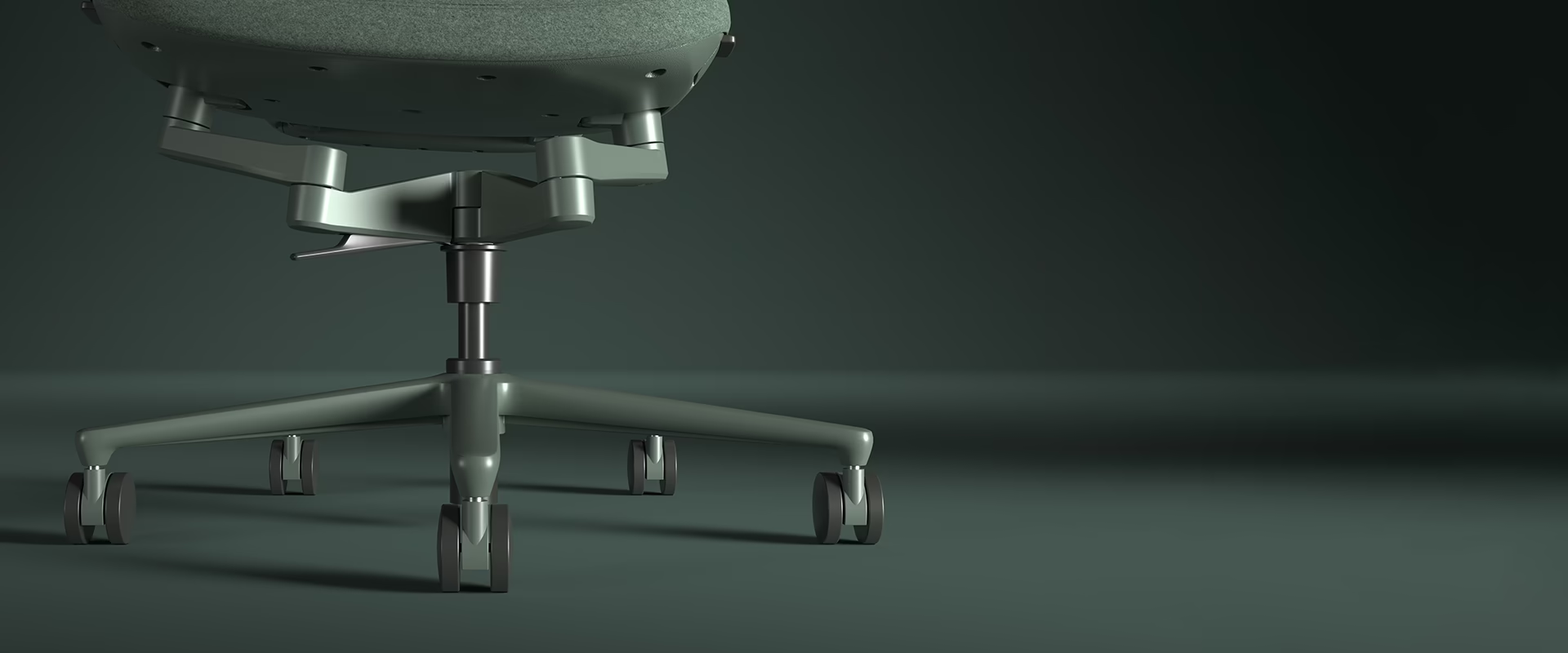
The Kiaura task chair has an architectural presence: the seat and back appear to float, supported by a mechanism that remains largely invisible. The lounge seating extends this language into softer, more inviting forms, with the same underlying Cognetic motion technology ensuring that even in a relaxed posture, the chair adapts rather than constrains. The occasional tables and ottomans coordinate through shared design details, creating visual continuity across an entire floorplate.

Ergonomics & how it supports the body
Drawing from insights across neuroscience, ergonomics, physical therapy, sports performance, and human factors design, KI's research reinforced a shared understanding: people benefit from continuous, varied movement throughout the day rather than remaining sedentary for extended periods of time. Cognetic Technology applies those principles directly into the seated experience, creating continuous motion that works naturally with the body throughout the workday rather than requiring users to constantly adjust or manage the chair.
The design directly addresses what scientists call the Sedentary-Cognitive Paradox: knowledge work inherently requires long periods at a desk chair, yet the human brain requires physical movement to sustain focus, clarity, and processing speed. DeJule's design addresses this by simultaneously uniting three pillars of human performance: mechanical ergonomics, physiological well-being, and neurocognitive support.
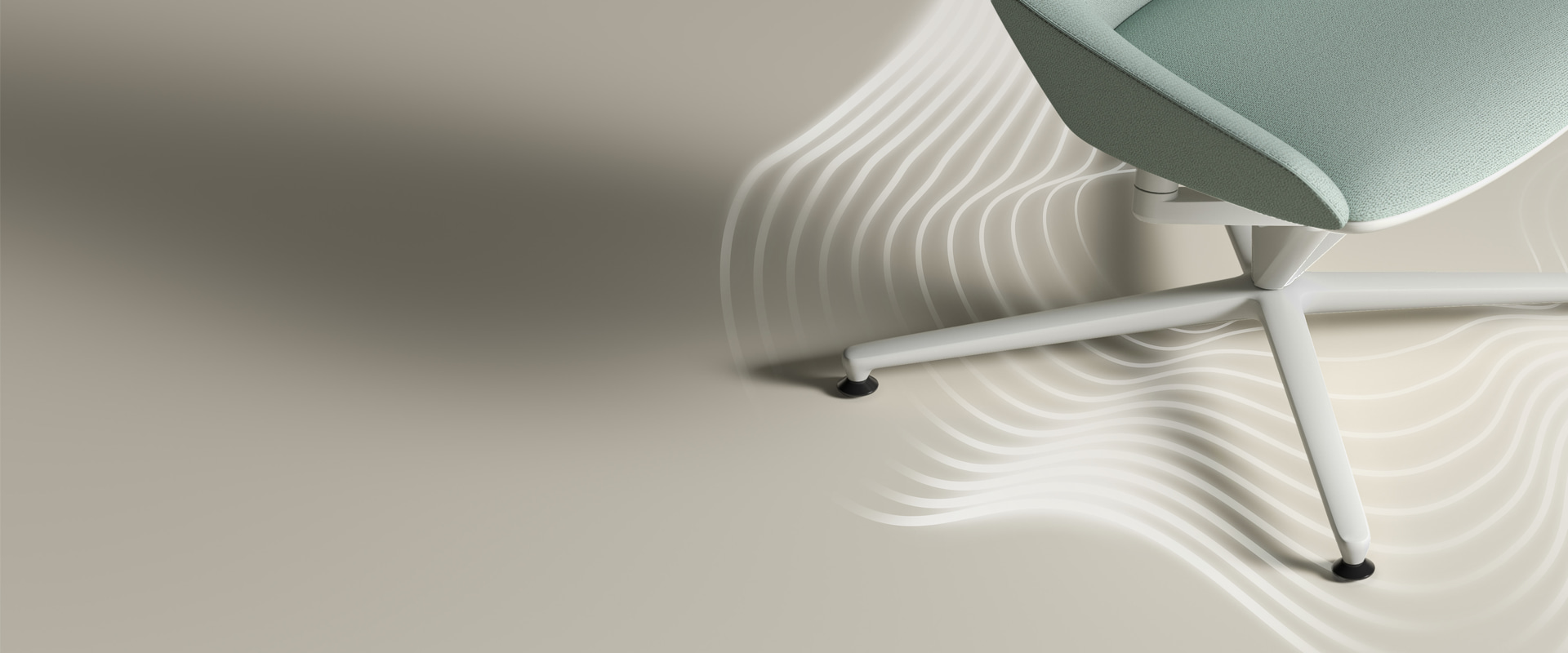
Traditional task chairs allow for movement on two planes—up and down and forward and back (if the chair includes a tilt option). Cognetic Technology allows you to move your hips forward and back and in a circle. By utilizing a gravity-powered, three-dimensional orbital motion, the technology responds to the body's natural micromovements rather than forcing the user to navigate adjustments and levers for comfort management. The technology moves away from traditional chairs that only tilt back and forth, side-to-side, and up and down, to designs that follow the body's center of gravity in every direction.
Early controlled studies associated with Cognetic Technology demonstrated measurable outcomes across multiple areas of seated performance and wellness. In a four-hour seated study, participants experienced reductions in anxiety, improvements in visual and auditory cognitive processing, and reduced lower back and pelvic discomfort during extended seated work sessions. During extended sitting periods, users experienced up to a 30% reduction in anxiety, improved cognitive processing, sustained focus, and a significant reduction in lower-back fatigue and compression at the close of the workday.
Key adjustments & mechanisms (recline, lumbar, armrests, seat depth)
Here's where the Kiaura departs radically from the conventional playbook. Driven by a completely passive, gravity-powered motion, the technology shifts into a subconscious experience that engages the body's internal regulatory systems without requiring effort or manual manipulation from the user. The entire premise is that you shouldn't have to think about adjusting the chair—it should simply respond.
Task and conference chairs within the collection include a lock-and-unlock feature that allows users to control movement when desired. Lounge models use a weight-activated automatic unlocking mechanism for a more seamless experience. This means the task version offers a simple toggle: motion on, or motion locked. When unlocked, the chair responds in real-time to your shifts in posture, your leaning, your reaching, your micro-adjustments. When locked, it functions as a stable, static platform.
Traditional adjustability—lumbar depth, armrest width and height, seat-pan depth, tilt tension—is either simplified or reconsidered. The chair's underlying assumption is that if the motion system is working correctly, many of those manual interventions become unnecessary. The seat and back move as a unified system, continuously rebalancing around your center of gravity. This is a bold claim, and one that will polarize: ergonomic purists who believe in granular control may feel the absence of twelve levers and knobs; others will find it liberating.
We cannot confirm the full suite of manual adjustments available on the Kiaura task model from public sources, but the emphasis throughout KI's messaging is clear: fewer controls, more intuitive motion.

Materials & build quality
The collection features advanced knit textiles, a broad material palette, and extensive specification flexibility. KI is a contract-furniture manufacturer with vertically integrated production in Green Bay; this is not flat-pack furniture designed for consumer self-assembly. The company's heritage is industrial-grade institutional seating—products built to withstand decades of continuous use in schools, hospitals, and government offices.
KI provides an industry-leading warranty—lifetime for many components—so you not only get the best products; you also get the peace of mind that comes from relying on the trusted expertise of KI. That warranty is backed by rigorous internal testing, BIFMA compliance, and an employee-owned manufacturing culture that emphasizes long-term durability over short-term cost-cutting.
The advanced knit textiles mentioned are likely engineered for breathability, cleanability, and resilience. The polished aluminum and monochromatic finishes suggest a focus on premium tactile and visual quality. The fact that the collection includes coordinated occasional tables and ottomans—complete with solid wood tops crafted in partnership with Purposeful Design—indicates a commitment to material authenticity and cohesive design systems.

Sitting experience — what it actually feels like day to day
We do not have firsthand long-term testing data, as the Kiaura Collection launched in June 2026. However, we can synthesize impressions from KI's marketing events and limited early exposure.
"The moment people experience a Kiaura Collection chair, the reaction is immediate and visceral," said Tony Besasie, chief sales and marketing officer at KI. "What they recognize right away is that the chair moves naturally with them instead of asking them to adapt to it." "The reaction is instinctive. People sit down and immediately recognize that it feels fundamentally different from traditional seating."
At KI's 'Flow Chamber' installation during Design Days, participants engaged with movement in a more intuitive and human-centered way, translating subtle seated motion into a feeling often described as light, balanced, and unexpectedly calming. Many participants described the sensation as 'cloud-like,' noting a reduction in the physical and mental tension commonly associated with prolonged sitting.
The experience seems to be one of continuous micro-adjustment rather than discrete tilt states. You lean forward to type, and the seat subtly shifts with you. You recline to think, and it follows. You shift your weight to one side, and the chair rebalances. The result, according to early reports, is a seated experience that feels less like sitting in a mechanism and more like floating on a responsive surface.
This will not be for everyone. If you're accustomed to the firm, locked-in feel of a traditional ergonomic task chair—where you set your lumbar depth, lock your tilt tension, and expect the chair to hold you in one precise position—the Kiaura's constant motion may initially feel disconcerting. But if you're someone who fidgets, shifts posture frequently, or has struggled with the static nature of conventional seating, the Kiaura may feel like the chair has finally caught up to how your body actually works.
Who it's for (and who should skip it)
Who should consider the Kiaura:
Knowledge workers who move constantly: If you shift posture every few minutes, lean in and out, or find yourself fidgeting in static chairs, the Kiaura's continuous motion may feel like a revelation.
Organizations specifying at scale: The coordinated task, conference, and lounge family makes the Kiaura ideal for firms looking to create unified design systems across an entire office or campus.
Designers prioritizing movement and wellness: If your brief emphasizes human performance, cognitive engagement, and physiological well-being—not just lumbar support—the Kiaura is purpose-built for that conversation.
Early adopters and innovation-led brands: This is a statement chair. If your organization wants to signal that it's at the forefront of workplace design, the Kiaura (and its Best of Competition award) delivers credibility.
Users with chronic discomfort in static chairs: If traditional task chairs leave you stiff, sore, or mentally fatigued despite perfect adjustment, the Kiaura's philosophy—that static sitting is the problem—may resonate.
Who should probably skip it:
Budget-conscious buyers: This is premium contract furniture, sold through KI dealers with custom quoting. If you're shopping for sub-$500 chairs, look elsewhere.
Ergonomic purists who demand granular control: If you need to dial in lumbar depth to the millimeter, adjust armrest pivot angles independently, and lock every axis, the Kiaura's simplified control philosophy may frustrate you.
Users who prefer firm, static support: If you like the feeling of a locked-down chair that holds you in one precise posture all day, the Kiaura's constant motion will feel wrong.
Small home offices without dealer access: The Kiaura is a commercial-grade product sold through contract channels. You can't just add it to a cart and check out. You'll need to work with a KI dealer, get a quote, and likely order as part of a larger specification.
Comparisons with key rivals
Chair | Price tier | Seat/back design | Key adjustments | Standout strength |
|---|---|---|---|---|
KI Kiaura (Cognetic) | Premium contract | Advanced knit textiles, gravity-powered multi-axis motion | Simplified (lock/unlock motion control); passive adjustment | Only chair with patented orbital gravity-responsive motion; best for continuous micro-movement |
Herman Miller Aeron | $1,200–2,500+ | Pellicle mesh suspension, PostureFit SL lumbar | Extensive (size-specific fit, tilt limiter, adjustable arms) | Gold-standard mesh breathability; iconic design; three sizes for precise anthropometric fit |
Steelcase Leap V2 | $800–1,800 | LiveBack flexing backrest, foam or fabric seat | Highly granular (4D arms, seat depth, lumbar height & depth) | Widest range of manual adjustments; LiveBack adapts to posture changes via flex, not motion |
Steelcase Gesture | $1,100–1,900 | Kinetic spine backrest, contoured seat | Extensive (360° arm movement, seat depth, lumbar) | Best armrests for multi-device work; designed for varied postures across devices |
The Kiaura doesn't compete with the Aeron or Leap on the same terms. The Aeron is about structured, breathable support and size-specific fit; the Leap is about maximum manual adjustability. The Kiaura is about eliminating the need for that adjustability by making the chair inherently responsive. It's closer in philosophy to active sitting concepts—but executed with contract-grade engineering and a premium industrial-design sensibility.
Sizing, fit & configuration options
KI has not publicly specified whether the Kiaura task chair comes in multiple sizes (like the Aeron's A/B/C) or a single universal size. Given the technology's premise—that the chair adapts to you—it's plausible that one size is intended to fit a wide range of users. However, this remains unconfirmed.
The collection offers monochromatic and polished aluminum finishes, customizable control colors, and tailored welting details. Beyond that, configuration options will depend on working with a KI dealer to specify fabrics, finishes, arm options, and base styles. This is a contract product, not a consumer SKU; expect a menu of choices rather than a simple dropdown.
If you're specifying for a large installation, KI's dealer network can guide you through finish palettes, sustainability options, and lead times. If you're an individual buyer, be prepared for a more consultative sales process.
Sustainability & certifications
KI is one of few select companies to earn a Green Master Award, the highest tier awarded by the Wisconsin Sustainable Business Council. KI achieved certification for 175 products under the Business and Institutional Furniture Manufacturers Association's (BIFMA) LEVEL® program, which ensures that products are produced in an environmentally and socially responsible manner.
In 2025, KI successfully diverted 5 million pounds of materials from landfills by channeling them into reuse and recycling streams. In 2025, KI showed a decrease of 8.14% in greenhouse gas emissions and 10.3% energy reduction. The company has established a baseline and goals for 25% reduction in greenhouse gas emissions by 2030.
We cannot confirm whether the Kiaura Collection specifically holds BIFMA LEVEL certification or GREENGUARD Gold certification, as the product launched in June 2026 and public certifications take time to process and publish. However, given KI's corporate sustainability track record and the fact that 175 of its products are already LEVEL certified, it would be reasonable to expect the Kiaura to pursue these credentials as part of its commercial rollout.
The use of advanced knit textiles and the partnership with Purposeful Design for solid wood occasional tables suggests an attention to material sourcing and social impact. KI's employee-owned structure and vertically integrated U.S. manufacturing also reduce supply-chain complexity and carbon footprint compared to globally distributed assembly models.

Maintenance, durability & warranty
KI is committed to producing the highest quality, most durable products. KI provides an industry-leading warranty—lifetime for many components—so you not only get the best products; you also get the peace of mind that comes from relying on the trusted expertise of KI. The Lifetime Warranty applies regardless of the number of shifts the product is used each day.
The warranty, which runs from the date of manufacture, covers defects in materials and craftsmanship found during normal usage of the products during the warranty period. The warranty is given to the initial purchaser and is valid for as long as the initial purchaser owns the product.
The Cognetic Technology mechanism is patented and proprietary; replacement parts and servicing will need to go through KI or authorized service partners. This is not a chair you can repair yourself with generic components. However, KI's dealer network and employee-owned commitment to quality suggest that long-term support will be taken seriously.
Daily maintenance should be straightforward: vacuum or wipe down upholstery, clean bases and controls as needed. The advanced knit textiles are designed for commercial durability, meaning they should resist pilling, fading, and staining better than residential-grade fabrics. Refer to KI's care and maintenance instructions for specific guidance.
Pricing, value & where it sits in the market
KI does not publish retail pricing for the Kiaura Collection on its website. For a formal price of the product shown, please request a quote. This is standard for contract furniture: pricing is dealer-negotiated, project-specific, and dependent on volume, configuration, and lead time.
Based on the chair's positioning—Best of Competition winner, patented technology, premium materials, coordinated collection—we can infer that the Kiaura task chair will sit in the upper tier of the commercial task-chair market. Expect pricing in the range of $1,200–2,000+ for a fully configured task chair, competitive with the Herman Miller Aeron Remastered, Steelcase Gesture, and Haworth Fern. The lounge seating and conference variants will be priced accordingly.
Is it worth it? That depends on what you're buying. If you're buying a chair, the Kiaura is expensive. If you're buying a seating system—task, conference, lounge, tables, ottomans, all speaking the same design language and underpinned by a unified motion philosophy—then the value proposition becomes more compelling, especially for large commercial installations where design coherence and occupant performance are strategic priorities.
The Kiaura is not competing with $300 mesh chairs from Amazon. It's competing with Steelcase, Herman Miller, and Haworth for corporate spec dollars, LEED credit contributions, and the attention of architects and interior designers specifying high-performance workplaces.
Verdict — the bottom line
The Kiaura Collection built with Cognetic Technology has been honored with seven 2026 Best of NeoCon Awards, including Best of Competition in Integrated Technology, one of the commercial design industry's highest distinctions recognizing groundbreaking product innovation and design excellence. The collection also received Best of NeoCon Gold in Seating: Ergonomic Task, Collections for Collaboration, Seating: Sofas + Lounge, Seating: Conference, and Lounge Furniture Collections. These are not participation trophies; NeoCon is the premier North American commercial interiors trade show, and Best of Competition is its top honor.
The Kiaura Collection is KI's moonshot: a deliberate attempt to shift the conversation from "how many adjustments does your chair have?" to "does your chair move with you or against you?" More than a product launch, the Kiaura Collection signals a broader shift in how seating can support human performance over time. With this introduction, KI is formally defining Human Performance Seating as a category that expands beyond traditional ergonomics to consider the relationship between movement, cognitive engagement, physical comfort, and physiological well-being.
Will it succeed? That depends on whether the market is ready to trust a chair that simplifies control in favor of passive, intuitive motion. Early reactions—"immediate and visceral," "cloud-like," "fundamentally different"—suggest that the experience is distinctive and polarizing. Some users will find it liberating; others will miss the granular adjustability of a Leap or Gesture.
For organizations specifying at scale, the Kiaura offers something rare: a cohesive, award-winning seating family built around a genuinely novel technology, backed by a century-old, employee-owned American manufacturer with a track record of durability and sustainability. It's not the cheapest chair, but it may be the most forward-thinking chair you can specify in 2026. If you're ready to stop managing your chair and start letting your chair manage itself, the Kiaura is the first serious commercial answer to that question.

Sources & references
Interested in the KI Kiaura?
Check the price on Amazon