Knoll Pollock Executive Armless Chair
Modernist icon held together by a single aluminum rim
Overview
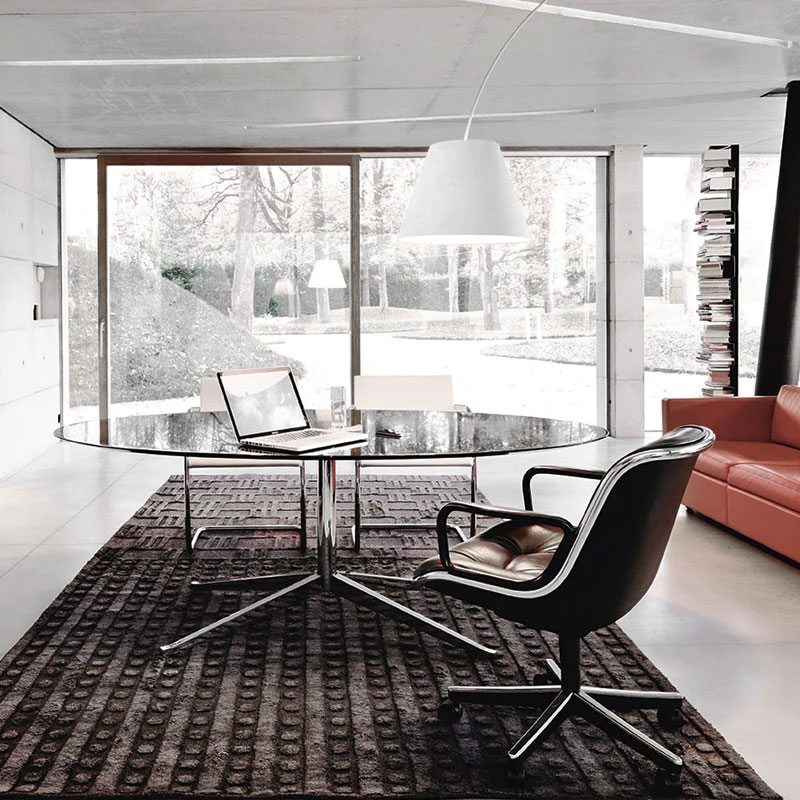
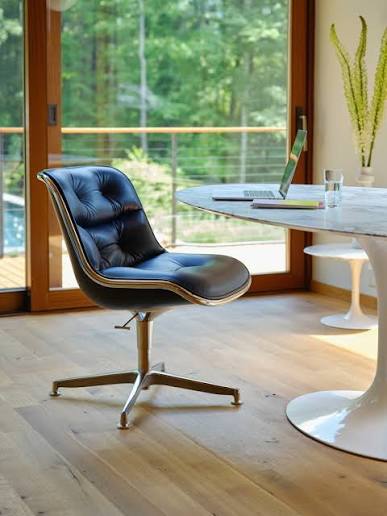
The Knoll Pollock Executive Armless Chair is an industrial design icon held together by a single aluminum band around its perimeter, introduced in 1965 and still in continuous production . The chair features what designer Charles Pollock called "rim technology"—the use of a single aluminum band around the chair's perimeter to hold the design together, structurally and visually . This is a mid-century modern executive chair distinguished by clean lines, button-tufted upholstery, and a waterfall-edge seat designed for all-day comfort in the office or home workspace.
At a glance
Brand | Knoll |
|---|---|
Designer | Charles Pollock |
Year introduced | 1965 |
Dimensions (armless) | 23.5″ W × 28.25″ D × 31–36″ H; seat height 18–23″ |
Weight | 44 lbs |
Shell material | Polypropylene (black textured) |
Frame | Extruded aluminum; steel support plate |
Upholstery | Multi-density urethane foam; button tufting detail |
Adjustments | 360° swivel, tilt with tilt tension, pneumatic seat height |
Base options | 5-star with casters (hard/soft) or 4-star with glides; polished or black anodized aluminum |
Warranty | 5 years |
Price tier | $2,568–$3,891 (US retail, depending on upholstery and finish) |
The brand & its philosophy
Founded in 1938, Knoll uses modern design to connect people to their work, their lives, their world; throughout its history, by embracing the creative genius at the Bauhaus School and the Cranbrook Academy of Art, Knoll has been recognized for creating residential and workplace furnishings that inspire, evolve, and endure . Knoll has remained true to the Bauhaus design philosophy that furniture should complement architectural space and not compete with it .
The company's portfolio of classic mid-century designs—including work by Mies van der Rohe, Eero Saarinen, Florence Knoll, and Harry Bertoia—sits alongside contemporary collaborations. The Pollock Executive Chair has been part of this canon for six decades.
The designer and the design story
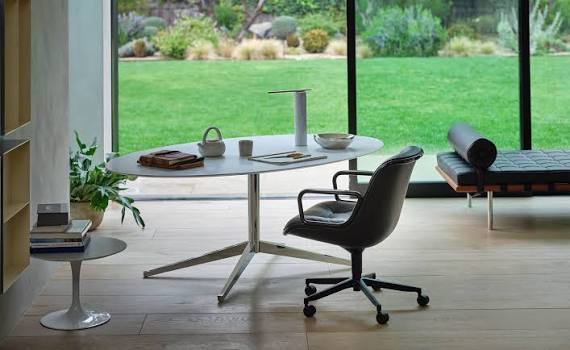
Born in Philadelphia, Charles Pollock began his design education at Cass Technical High School in Detroit, later won a scholarship to study at Pratt Institute (from which he graduated in 1953), and after serving in the United States Army for two years as art editor for INFANTRY Magazine, worked with George Nelson at Herman Miller . In 1958 he left Nelson's office and seeded a fruitful relationship with Florence Knoll through her retirement in 1965 .
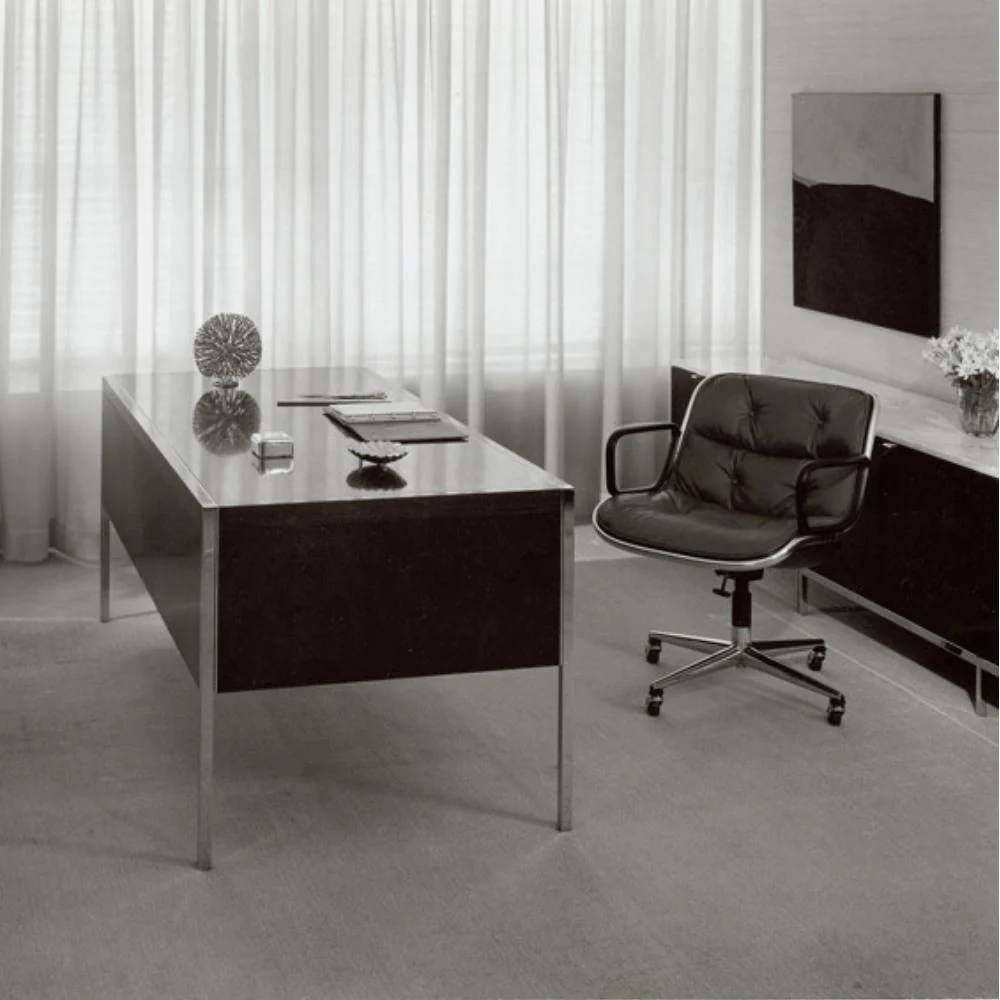
After graduating from Pratt and working with George Nelson, Charles Pollock assembled a portfolio of designs and presented them to Florence Knoll; Planning Unit member Vincent Cafiero saw promise in a leather and steel lounge chair and encouraged Pollock to keep working on the design, and the 657 Lounge, as it was introduced in 1961, showed the young designer's precision handling of line, form, and materials . Pollock again demonstrated his command of line and material when he conceived the 1250 series executive collection, introduced in 1965 . The Pollock Executive Chair has remained in continuous production since it was introduced by Knoll in 1965 . Introduced in 1965 and still in production, the chair became a staple of executive offices in the United States in the 1960s and can be seen in the period television show Mad Men, as well as institutions such as the Smithsonian Institution and the Metropolitan Museum of Art .
"Everything has an edge and everything is a line…I experimented with wire and curved the edge…I developed the idea of 'rim technology' and hit on the design." — Charles Pollock
Design language & aesthetics
Pollock's concept was an aluminum extrusion outlining the chair that would be the central structure, holding the parts together without any further support; slots in the aluminum rim secured the upholstery and back shell, which became rigid only once it was fitted into the rim . The structural rim doubles as a continuous visual signature, wrapping the entire seat and back in a gleaming band. The result is a sculptural, confident profile that looks equally at home in a Madison Avenue corner office or a modernist home studio.
The armless version offers an especially clean silhouette and makes it easier to slide under a desk or conference table. Featuring multi-density foam and button tufting, the Pollock Chair offers unmatched comfort and sophistication . The tufted upholstery—a hallmark of executive chairs from the period—adds texture and a slight formality, while the waterfall seat edge keeps the design youthful and uncluttered.
While Charles Pollock's initial idea was ingenious, people close to the project recall that it was Florence Knoll's legendary guidance and impeccable taste that pushed him to quiet the design down and reach his iconic final solution . This refinement is evident in every detail, from the understated black polypropylene shell to the precisely tailored upholstery.
Ergonomics & how it supports the body
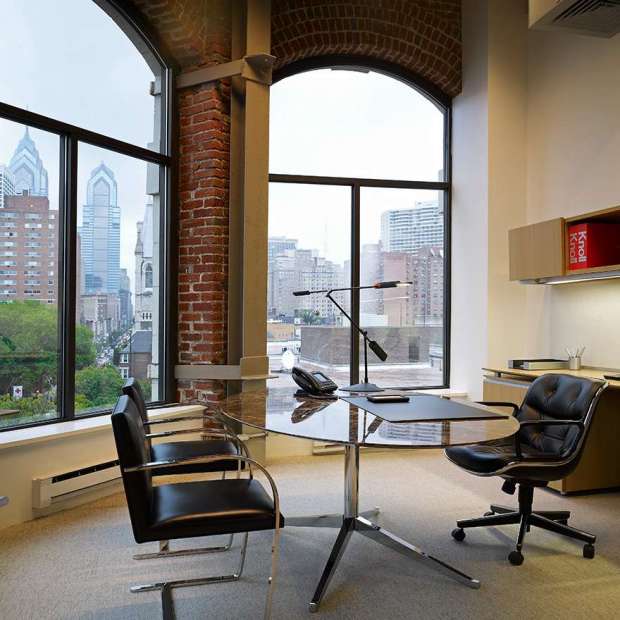
A waterfall seat edge and molded back contribute to enduring comfort; the height-adjustable seat also swivels and tilts . The chair's ergonomics are rooted in mid-1960s design thinking—simpler and less adjustable than today's high-end task chairs, but thoughtfully shaped to support long sitting sessions. The molded back shell provides gentle lumbar support through its contoured form, while multi-density urethane foam cushioning distributes pressure across the seat and back.
The waterfall front edge reduces pressure on the backs of the thighs, promoting circulation during extended work. The tilt mechanism allows you to recline slightly and shift posture throughout the day. There's no adjustable lumbar or seat-depth slider—the chair relies on its sculptural form and quality foam to accommodate a range of body types. For many users, especially those of average build, this simplicity is a strength: the chair simply fits, without fiddling.
Limitations for all-day intensive use
This is a mid-century executive chair, not a contemporary ergonomic task chair. Compared to modern rivals with adjustable lumbar, 4D arms, and seat-depth control, the Pollock offers a more static, form-over-function experience. Users accustomed to highly tunable chairs may miss those fine-grained adjustments.
Key adjustments & mechanisms
The Pollock executive series features 360 degree swivel, tilt with tilt tension and pneumatic seat height adjustment . In practice, this means three core adjustments: a gas-lift cylinder for seat height (approximately 18–23 inches), a tilt-lock/free-float mechanism that lets you rock gently backward, and a tilt-tension knob to adjust the resistance of that recline to your body weight.
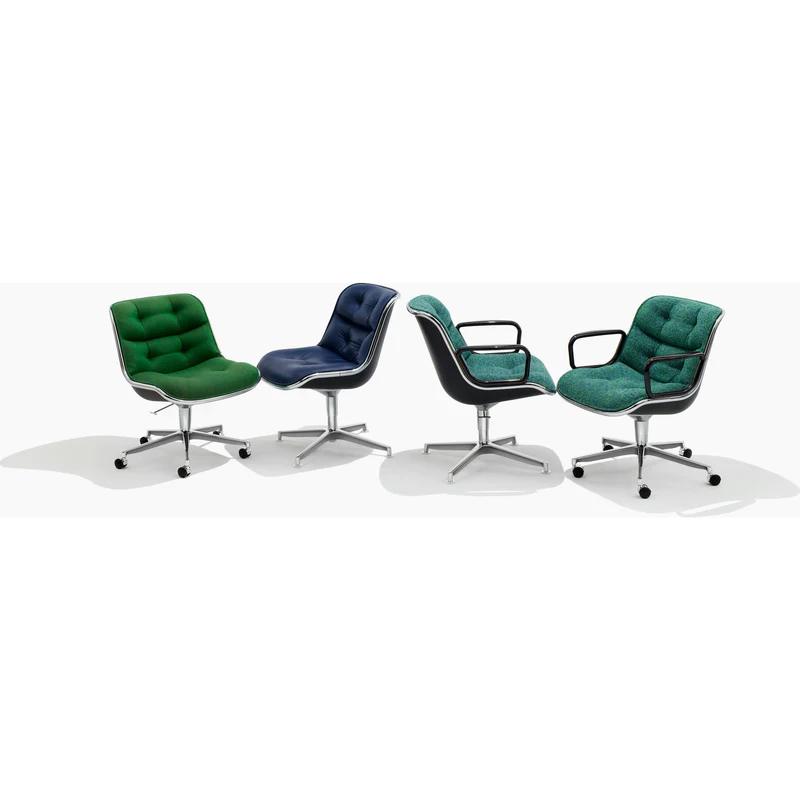
There are no armrests on the armless model—a deliberate choice for users who want maximum freedom of movement or need to tuck the chair under a shallow desk. The armed version offers fixed-height black phenolic arms, which are sleek but not adjustable in height, width, or angle. The base is available in either a 4-star configuration with glides (for stationary use) or a 5-star caster base for rolling mobility.
By contemporary task-chair standards the adjustment palette is minimal. There's no forward seat tilt, no adjustable lumbar dial, no seat-depth slider. What you do get is straightforward, reliable, and appropriate to the chair's executive lounge character.
Materials & build quality
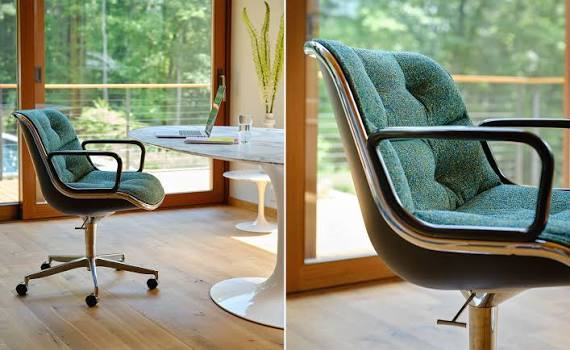
The outer shell is integrally colored, black textured polypropylene; the frame rim is extruded aluminum; there is a steel support plate; upholstery is multi-density urethane foam with button tufting detail; and arms (on the armed version) are seamless black phenolic plastic . The series is available with or without arms in a choice of polished or black anodized aluminum base .
The build quality is excellent—Knoll manufactures the chair in the USA to its original specifications, and the materials feel substantial. The aluminum rim is thick, smooth, and acts as both structure and bumper. Pollock explains: "It doesn't rust, it doesn't tarnish, it doesn't fade. It keeps its visual appearance almost forever." The polypropylene shell resists scuffs and wear, while the upholstery—available in a wide range of KnollTextiles fabrics and Spinneybeck leathers—can be tailored to office or home interiors.
Vintage Pollock chairs from the 1960s and 1970s are still in service in offices worldwide, a testament to the chair's durability. One owner on Medium reported using the same chair for twelve years with only minor cosmetic wear. The chair's simplicity also aids longevity: fewer moving parts mean fewer points of failure.
Sitting experience — what it actually feels like day to day
Sitting in the Pollock Executive Armless Chair feels poised and confident. The seat cushion is firm yet supportive—enough give to be comfortable over several hours, but not so soft that you sink or lose posture. The button tufting creates subtle peaks and valleys that help distribute pressure. The backrest wraps around your mid-back with a slight embrace; it's not aggressively contoured, but it provides a gentle push in the lumbar region.
The armless configuration gives you complete freedom to swivel, lean forward over a keyboard, or drape one leg over the seat edge—useful for casual, creative work. The tilt recline is smooth and satisfying, with enough resistance to feel controlled. Because the chair is relatively compact, it's easy to pull up close to a desk or conference table.
Over a full workday, the Pollock feels dignified and supportive, though not as forgiving as a mesh-backed ergonomic task chair. You're aware you're sitting on a piece of design, and that awareness can be part of the appeal. The chair encourages good posture without enforcing it. For users who shift between focused desk work and casual meetings, the Pollock strikes a balance between formality and comfort.
Who it's for (and who should skip it)
Ideal for:
Design-conscious professionals who want a chair that doubles as a showpiece—architects, creatives, executives in modernist interiors.
Home-office users seeking mid-century authenticity and timeless style over maximum adjustability.
Conference and meeting spaces where the chair will be occupied for shorter periods and visual impact matters.
Collectors and mid-century enthusiasts who appreciate the chair's place in design history and its continuous production lineage.
Users of average height and build (5'4″–6'0″, 120–200 lbs) who fit the chair's fixed proportions comfortably.
Skip it if:
You need highly tunable ergonomics: no adjustable lumbar, seat depth, or armrests.
You're significantly taller or shorter than average: the fixed back height and seat depth may not suit outlier body types.
You sit 8+ hours daily in intensive postures: contemporary task chairs like the Steelcase Leap or Herman Miller Aeron offer more dynamic support for prolonged computing.
You're budget-constrained: at $2,500+ new, the Pollock is a premium design piece, not an entry-level office chair.
Comparisons with key rivals
Chair | Price (approx.) | Seat & back | Adjustments | Standout strength |
|---|---|---|---|---|
Knoll Pollock Executive Armless | $2,568–$3,891 | Upholstered shell, button tufting | Height, tilt, tilt tension | Iconic rim-tech design; mid-century pedigree |
Herman Miller Eames Executive | $2,500–$4,000+ | Leather on molded aluminum | Height, tilt | Timeless Eames aesthetic; lounge-chair comfort |
Knoll Generation | $900–$1,400 | Flex back, flex seat | Height, tilt (3 ranges), adjustable lumbar | Modern ergonomics; GREENGUARD Gold, BIFMA Level 3 |
Herman Miller Aeron (remastered) | $1,600–$2,000 | 8Z Pellicle mesh | Height, lumbar, tilt, arms (4D), seat depth | Best-in-class adjustability and all-day ergonomics |
The Pollock sits in a niche between heritage executive seating and contemporary task chairs. If you prize design provenance and visual impact over maximal adjustability, it competes directly with the Eames Executive and vintage Saarinen executive chairs. For purely ergonomic performance, the Aeron and Knoll's own Generation chair pull ahead—but neither carries the same mid-century cachet.
Sizing, fit & configuration options
The Pollock Executive Chair is a one-size-fits-most design. The armless version measures 23.5″ W × 28.25″ D × 31–36″ H, with seat height adjustable from 18″ to 23″ . This range accommodates users roughly 5'4″ to 6'1″ comfortably. Taller or shorter users may find the fixed back height and seat depth less ideal.
Configuration options include: with or without arms; 5-star base with castors or 4-star base with glides; frame in polished chrome or black anodised finish . Upholstery is fully customizable through Knoll's range of fabrics and leathers, from classic black leather to bright KnollTextiles. The armless version is roughly 3 inches narrower than the armed variant, making it easier to slide under desks or cluster around a table.
Sustainability & certifications
Knoll's broader product line has strong sustainability credentials— all KnollStudio products are GREENGUARD-certified for indoor air quality , and the company's manufacturing facilities hold ISO 14001 environmental certification. However, specific certifications for the Pollock Executive Chair (such as BIFMA Level or GREENGUARD Gold) are referenced only generically on Knoll's Ecomedes page; detailed data sheets are available through authorized dealers.
The chair's longevity is itself a sustainability argument: a well-maintained Pollock can last decades, reducing the need for replacement. The aluminum rim and steel components are fully recyclable at end-of-life, and Knoll's Full Circle Program offers take-back and refurbishment services for contract clients.
Maintenance, durability & warranty
Knoll offers a 5-year warranty (terms and conditions apply) on the Pollock Executive Chair, covering defects in materials and workmanship. This is standard for Knoll's executive seating and shorter than the 12-year warranties offered on contemporary task chairs like the Generation, but reflects the chair's simpler mechanical design.
Day-to-day maintenance is straightforward. Leather upholstery benefits from periodic conditioning; fabric versions can be vacuumed and spot-cleaned. The aluminum rim resists corrosion and maintains its finish with occasional wiping. The tilt mechanism and gas cylinder are serviceable through Knoll dealers. Anecdotal reports from long-term owners suggest the chair ages gracefully—developing a patina rather than breaking down.
Pricing, value & where it sits in the market
Knoll lists the Pollock Executive Chair at $2,568 to $3,891 depending on upholstery and finish . This places it firmly in the premium/luxury tier, comparable to the Eames Executive Chair and well above most contemporary ergonomic task chairs.
You're paying for heritage design, American manufacturing, and a seat in the permanent collections of the Met and the Smithsonian. The chair holds its value well—vintage Pollock chairs in good condition routinely sell for $800–$1,500 on the secondary market, and some enthusiasts prefer the earlier production bases. For design-focused professionals, the Pollock offers lasting style and reasonable comfort. For ergonomics-first buyers, it's harder to justify the premium over an Aeron or Leap.
New chairs are available through Knoll showrooms, Design Within Reach, and authorized dealers. Lead times vary; in-stock configurations can ship within a few weeks, while custom upholstery may take 8–12 weeks.
Verdict — the bottom line
The Knoll Pollock Executive Armless Chair is a mid-century design masterpiece that remains relevant sixty years after its debut. Its structural aluminum rim is as ingenious today as it was in 1965, and the chair's clean, sculptural profile brings instant sophistication to any workspace. The sitting experience is comfortable and dignified, with just enough adjustability for daily office use—though it can't match the fine-tuned ergonomics of contemporary task chairs.
This is a chair for design lovers who value provenance, craftsmanship, and timeless style. If you spend your days in a modernist interior and want a seat that serves as both functional tool and design statement, the Pollock delivers. If you prioritize maximal lumbar support, mesh breathability, and granular adjustability over aesthetics, look elsewhere—the Aeron, Leap, or Knoll's own Generation chair will serve you better.
A singular piece of mid-century engineering that still earns its place in the modern office—provided you prize design as much as ergonomics.
Sources & references
Interested in the Knoll Pollock Executive Chair?
Check the price on Amazon