Knoll Saarinen Tulip Arm Chair
Eero Saarinen's sculptural icon—designed for dining, not desking
Overview
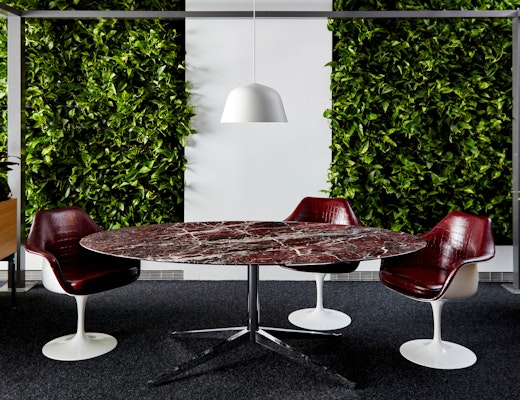
The Tulip chair was designed by Eero Saarinen in 1955 and 1956 for the Knoll company of New York City. The Tulip Chair, and accompanying Pedestal Table, have since become symbols of mid-century modern design and mainstays of the Knoll design legacy. This is not an office chair in the conventional sense—it was conceived as a dining chair, part of the broader Pedestal Collection, with a focus on visual purity and sculptural form rather than ergonomic task support. Some design enthusiasts do use the Tulip Arm Chair at a desk, drawn by its iconic silhouette and swivel function, but it offers none of the adjustments, lumbar mechanisms, or prolonged sitting comfort expected of a dedicated office chair.
At a glance
Brand | Knoll |
|---|---|
Designer | Eero Saarinen |
Year introduced | 1956–57 |
Primary use | Dining chair (occasionally used at desks) |
Dimensions (Arm Chair) | 26″W × 23.25″D × 32″H; 18″ seat height |
Shell material | Molded fiberglass-reinforced plastic |
Base material | Cast aluminum with Rilsan or powder-coat finish |
Adjustments | None (swivel seat only) |
Certifications | GREENGUARD Indoor Air Quality; Intertek Clean Air GOLD |
Warranty | 5 years |
Price tier | Premium / design collectible ($3,400–$4,300 MSRP new for armchair) |
Weight capacity | Not publicly specified by Knoll |
Made in | Italy (authentic Knoll production) |
The brand and its philosophy
Since 1938, Knoll has been recognized for creating modern furniture that inspires, evolves, and endures. Steeped in the history of modernism, our vision is carried forward today by the most talented contemporary designers. Knoll's identity was forged in the post-war decades through collaborations with giants like Mies van der Rohe, Florence Knoll, and Eero Saarinen. Knoll has always remained true to the Bauhaus design philosophy that modern furniture should complement architectural space, not compete with it.
The company holds exclusive manufacturing rights to Saarinen's Pedestal Collection. Each chair is stamped with the KnollStudio logo and Eero Saarinen's signature. This is the authentic Saarinen Tulip Chair produced by Knoll. Made in Italy. That Italian craftsmanship, combined with strict adherence to Saarinen's original drawings, distinguishes genuine Knoll pieces from the flood of replicas on the market.
The designer and the design story
The Finnish-American architect grew up surrounded by design. His father, Eliel Saarinen, was a well-known architect and his mother, Loja Saarinen, was a talented sculptor and textile maker. By the time he was a teenager, Eero was designing furniture and fixtures with his father, who was president at the prestigious Cranbrook Academy of Art in Michigan. In 1929, Eero left for Paris to study sculpture at the Académie de la Grande Chaumière and the following year enrolled in the Yale architecture program. In the '30s, he followed in his father's footsteps and joined the family firm, also returning to teach at Cranbrook, which is where he became friends with Florence Knoll and Charles Eames, who turned into formative collaborators.
In the late '50s, Eero designed the Pedestal Collection for Knoll to alleviate the visual clutter he famously hated in American homes caused by a jumble of furniture legs in one room. "The undercarriage of chairs and tables in a typical interior makes an ugly, confusing, unrestful world," he said. "I wanted to clear up the slum of legs." A five-year design investigation led him to the revolutionary Pedestal Collection, including the Tulip Chair. He worked first with hundreds of drawings, which were followed by ¼ scale models. Since the compelling idea was to design chairs that looked good in a room, the model furniture was set up in a scaled model room the size of a doll house. Drawing on his early training as a sculptor, Saarinen refined his design through full scale models, endlessly modifying the shape with clay.
"I wanted to clear up the slum of legs. I wanted to make the chair all one thing again." – Eero Saarinen
Design language and aesthetics
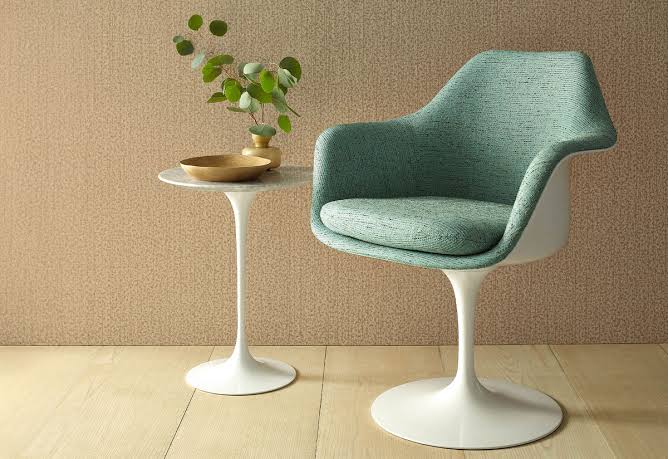
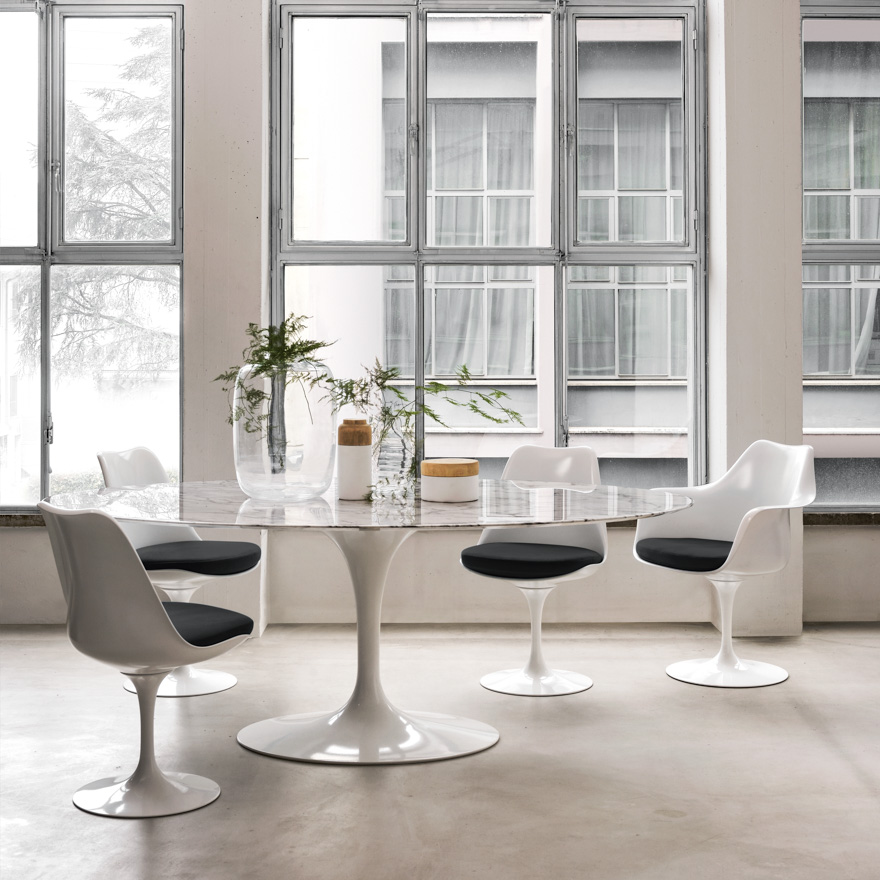
The chair is often considered "Space Age" for its futuristic use of curves and artificial materials. The Tulip Armchair, which resembles the flower but also a stemmed wineglass, is part of Saarinen's last furniture series. Its single-pedestal form is immediately recognizable: a gracefully flared shell sits atop a slender stem that widens into a circular base. Inspired by a drop of high viscosity liquid, the shapely base reduces visual noise. Available as a side chair, armchair, and stool, the comfortable seat swivels for easy entry and exit from the table.
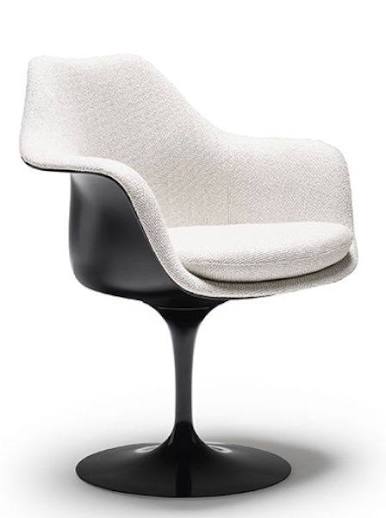
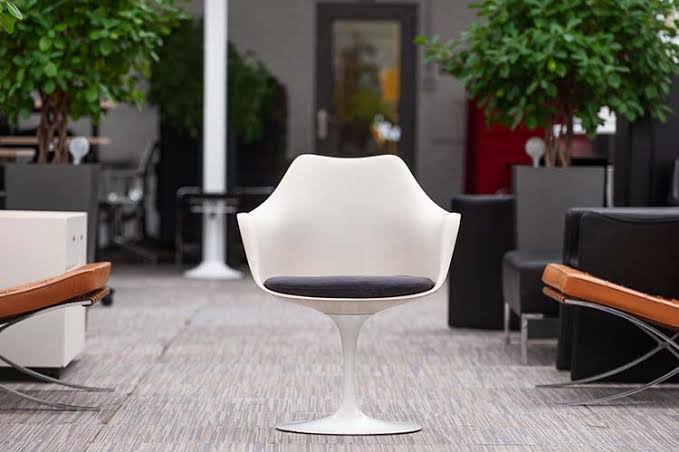
The Arm Chair variant features integrated arms that gently curve outward— the armchair's integrated arms gently unfurl at the edges, rather reminiscent of a flower petal. The entire form flows as a continuous sculptural gesture, minimal yet organic. Available in white or black finish (with a rarer platinum option), the chair reads as a unified whole, reinforcing Saarinen's purist vision of "one leg, one material" (even if, in reality, two materials were required for structural integrity).
Ergonomics and how it supports the body
Here is where the Tulip Arm Chair diverges sharply from true office seating: it offers virtually no ergonomic adjustability or targeted body support. The shell is a fixed, molded shape with a gentle recline built into the backrest. The seat cushion is thin and upholstered, designed for meal-length sitting rather than eight-hour workdays. There is no lumbar adjustment, no recline tension control, no seat-depth slider, and no headrest.
The 18-inch seat height is standard for dining; the swivel base allows you to turn and exit gracefully from a table. But the lack of depth in the seat pan and the minimal back angle mean that extended sitting can feel constraining. The integrated armrests are at a fixed height and width—useful for momentarily resting forearms while dining, less so for typing ergonomics or supporting a range of body sizes during desk work.
Key adjustments and mechanisms
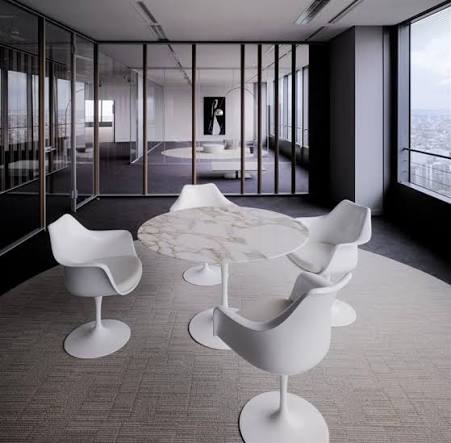
The Tulip Arm Chair has exactly one "adjustment": The seat swivels for easy entrance to or exit from a table. That's it. No height adjustment (the chair is a fixed-height design), no tilt mechanism, no armrest height or width controls, no lumbar dial. This is by design—Saarinen's concept prioritized sculptural unity and visual simplicity, not adaptability for diverse body types or tasks.
If you're used to the control suite of a Herman Miller Aeron, Steelcase Gesture, or even a basic office task chair, the Tulip will feel static and non-responsive. It is fundamentally a dining chair with a swivel, not a posture-supporting work chair.
Materials and build quality
The base of the tulip chair is of cast aluminum with a rilsan-coated finish to match the upper shell, giving the appearance of a single unit. The upper shell is molded fiberglass, with a reinforced, plastic bonded finish. The upholstered foam cushion is removable with Velcro fastening. The fiberglass shell is durable, rigid, and lightweight. The cast aluminum base is heavy and stable, providing a solid platform for the swivel.
Authentic versions are manufactured by Knoll and handmade in Italy, using superior materials and precise proportions that replicas rarely match. The surface finish is smooth and glossy. Cushions can be specified in a wide range of Knoll Textiles and Spinneybeck leathers. And today they are made exactly the same as they were when they first went into production in 1958. This manufacturing continuity and attention to detail justify Knoll's premium pricing—though replicas abound at a fraction of the cost.
Sitting experience—what it actually feels like day to day
Sitting in an authentic Tulip Arm Chair feels sculptural and composed. The shell cradles you in a fixed posture; the swivel adds a touch of playfulness. For a 90-minute dinner party, it's elegant and comfortable. For a two-hour Zoom marathon, it begins to feel rigid. The seat cushion offers modest padding but little contouring. Your lower back contacts the shell directly or via the cushion edge, with no dynamic lumbar support.
The arms are gracefully shaped but low and wide-set; typing on a standard desk can feel awkward unless the desk height is just right. The fixed 18-inch seat height may be too low for taller desks or too high for shorter users without a footrest. Because there's no recline or tension adjustment, you can't lean back and stretch—your posture stays relatively upright and static.
In short, the Tulip Arm Chair is a pleasure to look at and a fine perch for short spells. Extended work sessions reveal its limitations: it simply wasn't designed to support long hours of focused, computer-based work.
Who it's for (and who should skip it)
This chair is for:
Mid-century modern enthusiasts who prize iconic design and are willing to accept ergonomic trade-offs for aesthetic purity.
Dining rooms and occasional desk use—a home office where you spend an hour or two a day, not a full-time workstation.
Collectors and design-conscious spaces (boutique offices, creative studios, showrooms) where the chair serves as a design statement as much as functional seating.
Smaller-framed individuals who fit comfortably within the shell's fixed dimensions and don't require height or depth adjustment.
Skip this chair if you:
Need genuine ergonomic support for 6–8 hour workdays.
Require adjustability for lumbar support, seat depth, armrest height, or recline tension.
Are tall, heavy, or outside the "average" frame the shell was molded for (Knoll does not publish a weight capacity).
Work at a desk that demands dynamic posture changes, forward tilt, or headrest support.
Want practical, budget-conscious office seating—the Tulip's price reflects design heritage, not task-chair functionality.
Comparisons with key rivals
Model | Type | Adjustments | Price tier | Standout strength |
|---|---|---|---|---|
Knoll Saarinen Tulip Arm Chair | Dining chair (swivel) | None (swivel only) | $3,400–$4,300 | Iconic mid-century design; sculptural purity |
Herman Miller Eames Aluminum Group Chair | Dining/conference chair | Tilt-swivel, fixed height | $1,800–$2,600 | Breathable mesh suspension; more office-appropriate tilt |
Herman Miller Aeron (size B) | Office task chair | Height, tilt, lumbar, arms, forward tilt | $1,600–$1,900 | Full ergonomic suite; designed for 8-hour days |
Fritz Hansen Series 7 (3207 armchair) | Dining/side chair | Swivel option; no height adjust | $800–$1,200 | Arne Jacobsen classic; molded plywood; lower cost |
The Eames Aluminum Group and Series 7 are closer comparisons—design-forward chairs sometimes adapted for light office use—but even they offer more tilt or recline than the static Tulip. The Aeron is a fundamentally different animal: purpose-built for task work, adjustable in every dimension, and priced below the Tulip despite superior ergonomic engineering. The Tulip's value proposition is design legacy, not work performance.
Sizing, fit, and configuration options
Dimensions: 26″w | 23.25″d | 32″h | 18″ seat height for the Arm Chair. The Side Chair (armless version) is narrower at 20″W. These dimensions are fixed—there are no size variants or height adjustments. The Saarinen Tulip seating collection consists of an armchair and an armless chair, with swivel or fixed base. The chairs are available with either an upholstered seat cushion, or fully upholstered inner shell with seat cushion.
Configuration options include:
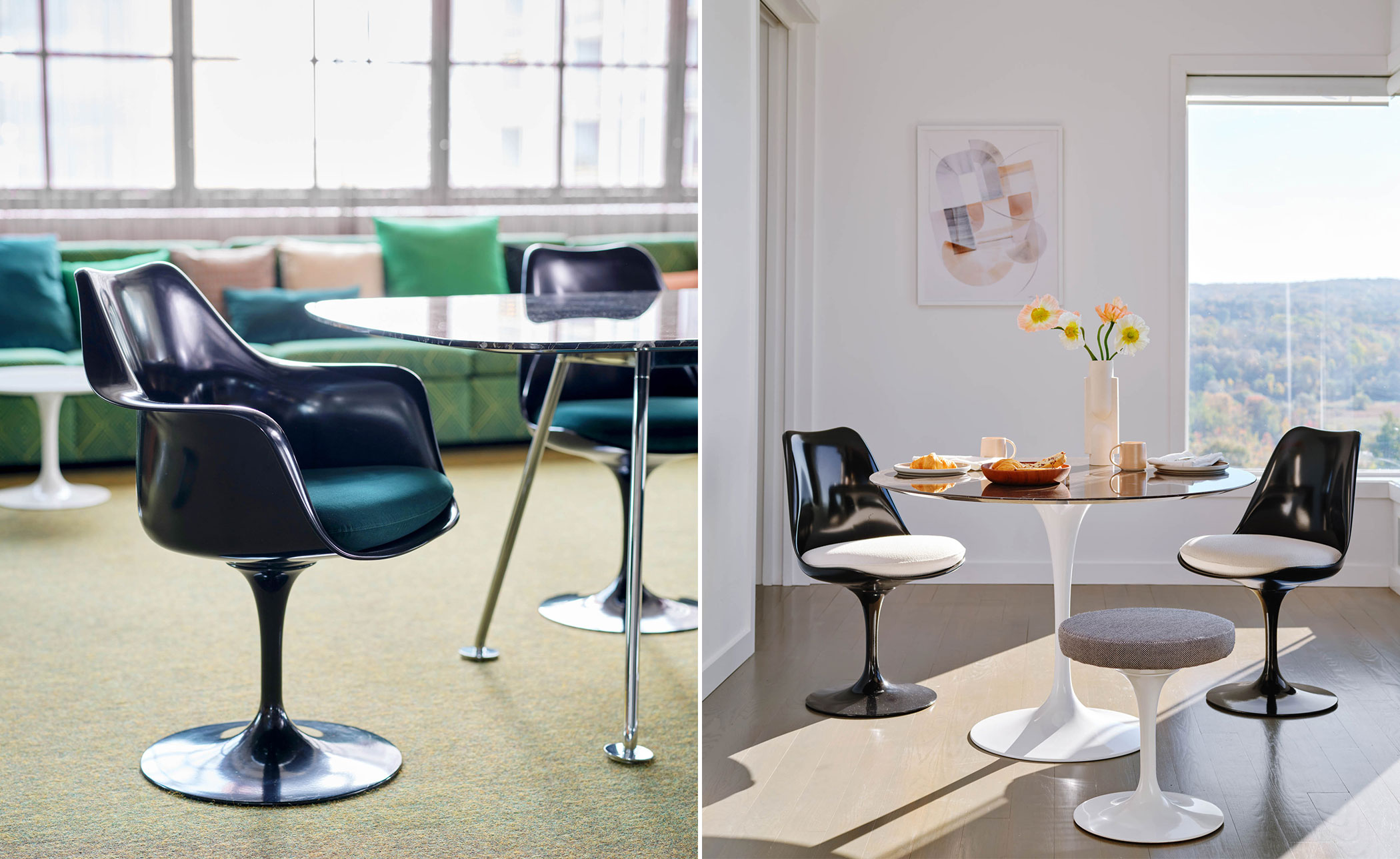
Shell/base finish: White or black (both base and shell match); platinum is occasionally available.
Cushion: Seat cushion only, or fully upholstered inner shell. Cushions can be specified in hundreds of fabrics (Knoll Textiles) and leathers (Spinneybeck).
Base: Swivel or fixed (non-swivel). Most users opt for swivel, which is standard for the dining chair version.
If the seat height or shell width doesn't suit your body, there's no way to adjust it—you're either a fit or you're not.
Sustainability and certifications
The Tulip Collection is Greenguard Indoor Air Quality Certified. Products certified Intertek Clean Air GOLD are certified for low-VOC emissions and conform to ANSI/ BIFMA e3 standard credits 7.6.1, 7.6.2 and/or credit 7.6.3, which includes California Department of Public Health (CDPH) Standard Method v1.2 01350 (2017), as well as conformance to low-emitting materials for WELL and LEED. This makes the chair suitable for green building projects and health-conscious interiors.
Knoll does not prominently advertise recycled-content percentages or end-of-life take-back programs for the Tulip Collection, though the company has broader sustainability initiatives. The chair's longevity is itself a sustainability argument: an authentic Tulip, well maintained, can last decades and hold resale value, avoiding landfill waste. The fiberglass shell and aluminum base are both technically recyclable, though disassembly and material separation are not trivial.
Maintenance, durability, and warranty
5-year warranty Terms and conditions apply. This is Knoll's standard coverage for the Tulip Collection, covering defects in materials and workmanship. The fiberglass shell is highly durable and resistant to cracking under normal dining use; the powder-coated aluminum base resists chipping and corrosion. The upholstered cushion can be removed and cleaned or reupholstered over time.
Maintenance is straightforward: wipe the shell with a damp cloth; vacuum and spot-clean the cushion. Avoid abrasive cleaners on the glossy fiberglass. The swivel mechanism is simple and long-lived, with minimal moving parts. Vintage Tulip chairs from the 1960s and 70s still function well today, testament to the design's robustness. However, daily office use (especially by heavier users or those who shift and swivel constantly) may accelerate wear on the cushion and base compared to occasional dining use.
Pricing, value, and where it sits in the market
As of mid-2026, the Saarinen Tulip Arm Chair retails for approximately $4,240 (original price) with periodic 20% off sales bringing it to $3,392 direct from Knoll or Design Within Reach (Knoll's retail arm). Prices vary by upholstery choice; leather and premium fabrics can push the figure higher. The Side Chair (armless) is somewhat less expensive, typically in the $3,108 range ($2,486 on sale) .
For context, prices for a knoll tulip chair can differ depending upon size, time period and other attributes — at 1stDibs, they begin at $495 and can go as high as $15,000, while the average can fetch as much as $4,472. Vintage authenticated pieces can command premium prices; replicas flood the market at $200–$800, though "Every 'reproduction' of the design sacrifices something — proportions, materials, functionality, quality etc. — in pursuit of the form," says Knoll's communications associate, Todd Cooke.
The Tulip Arm Chair is priced as a design collectible, not as task seating. You're paying for Eero Saarinen's name, MoMA-certified design history, Italian manufacturing, and the Knoll imprimatur. Compared to purpose-built office chairs (Aeron, Gesture, Leap) priced $1,200–$1,900, the Tulip is more expensive yet less functional for desk work. Its value lies in aesthetic cachet and long-term collectibility.
Verdict—the bottom line
The Knoll Saarinen Tulip Arm Chair is an undeniable icon of 20th-century design—sculptural, elegant, and instantly recognizable. The chair is considered a classic example of industrial design. In 1969, the Tulip Chair received the Design Award of the New York Museum of Modern Art and the Federal Award for Industrial Design. These posthumous awards confirm Saarinen's role in the history of design. But let's be clear: this is a dining chair, occasionally pressed into service at a desk for its looks. It offers zero ergonomic adjustments, minimal padding, and a fixed posture that will feel rigid after a few hours of work.
If you run a design-focused boutique office, work short hours from home, or simply want a sculptural statement piece at your writing desk, the Tulip Arm Chair delivers unmatched mid-century charisma. For full-time office seating—especially in commercial or intensive home-office settings—it's the wrong tool for the job. Buy it for what it is: a museum-quality design object that happens to have a seat. Just don't expect it to support your spine through a 40-hour week.
An icon of form over function—breathtaking to behold, punishing for long hours at a desk.
Sources & references
Interested in the Knoll Tulip Chair?
Check the price on Amazon