Herman Miller Cosm
Studio 7.5's self-adjusting mesh chair for the design-first office

Overview
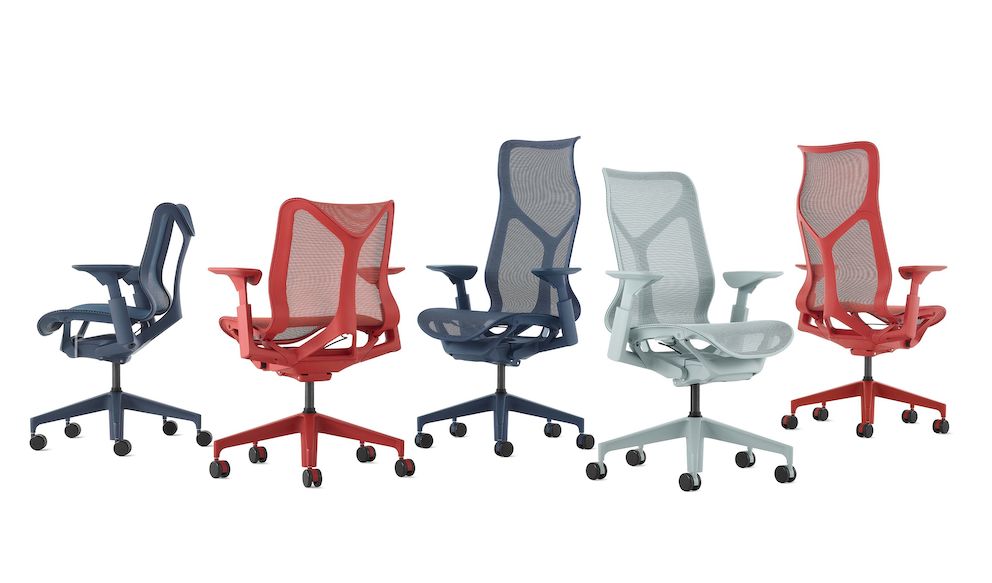
The Cosm chair, designed by Studio 7.5 for Herman Miller, is a self-adjusting mesh chair with a focus on high design —one that aspires to make sitting as frictionless as possible. Named one of the 100 Best Inventions in 2019 by Time magazine , the Cosm launched in 2018 and immediately distinguished itself with three signature technologies: an Auto-Harmonic Tilt that calibrates to the sitter's weight without manual adjustment, an Intercept suspension mesh that spans seat and backrest in one continuous form, and industry-first Leaf Arms. For the Berlin-based designers at Studio 7.5, the chair represents "a design that creates a new reference point for instant, personalized comfort" . It's a design-forward chair for users who prefer simplicity and aesthetics over granular adjustability—and who are willing to pay a premium for both.
At a glance
Brand | Herman Miller |
|---|---|
Designer | Studio 7.5 (Carola Zwick, Roland Zwick, Burkhard Schmitz) |
Year introduced | 2018 |
Back heights | Low, Mid, High |
Key materials | Intercept suspension mesh, flexible polymer frame, aluminum/steel base |
Adjustments | Pneumatic seat height, auto-harmonic tilt; optional adjustable arms (fixed, Leaf, or fully adjustable) |
Weight capacity | 350 lbs |
Warranty | 12 years, 3-shift, no excluded parts |
Country of origin | Made in USA |
Price tier | Starting at $1,800 (2026) |
The brand & its philosophy
Herman Miller is one of the most well-known and well-respected office furniture brands in the world, in business since 1923 (originally as the Michigan Star Furniture Company). Herman Miller is now a publicly traded company with factories in the US, China, Italy and the UK . The brand has built its reputation on design-led innovation—partnering with legendary designers and studios to create chairs that become cultural icons, from the Eames Lounge to the Aeron. Herman Miller has established itself as one of the leaders in the high-end office furniture world; its chairs all have a story and go through an extensive design and engineering process . With Cosm, that ethos translates into a chair that prizes seamless, automatic ergonomics alongside sculptural beauty.
The designer and the design story
The Cosm chair was designed by Studio 7.5, based in Berlin, Germany, and in business since 1992 . Burkhard Schmitz and Carola Zwick started the studio as a team of six in Berlin in 1992, looking for the freedom to work on projects that interested them, and for the freedom to do so without bosses or titles . Today, the team includes Carola's brother Roland Zwick and a small group of designers. The group's name, Studio 7.5, comes from an early idea to rent a 7.5-ton truck, put a model shop in it, and drive from one project site to another —a cheeky nod to their ethos of mobility and hands-on experimentation.
Studio 7.5 is responsible for designing other well-known chairs for Herman Miller like the Mirra, Mirra 2 and Setu, and spent years designing and refining the Cosm to get to the final version . Cosm's Auto-Harmonic Tilt has been a goal Studio 7.5 worked toward for years; the designers knew, even when working on predecessors like Mirra, Setu, and Mirra 2, that the ideal chair would provide a smooth feeling of natural balance . The journey of the self-adjusting tilt spanned over eighteen years . Cosm was designed through inheriting the iterative design practice of Charles and Ray Eames; instead of designing primarily in the computer, Studio 7.5 used sculpting and 3D printing to bring each iteration into the physical world .
Design language & aesthetics
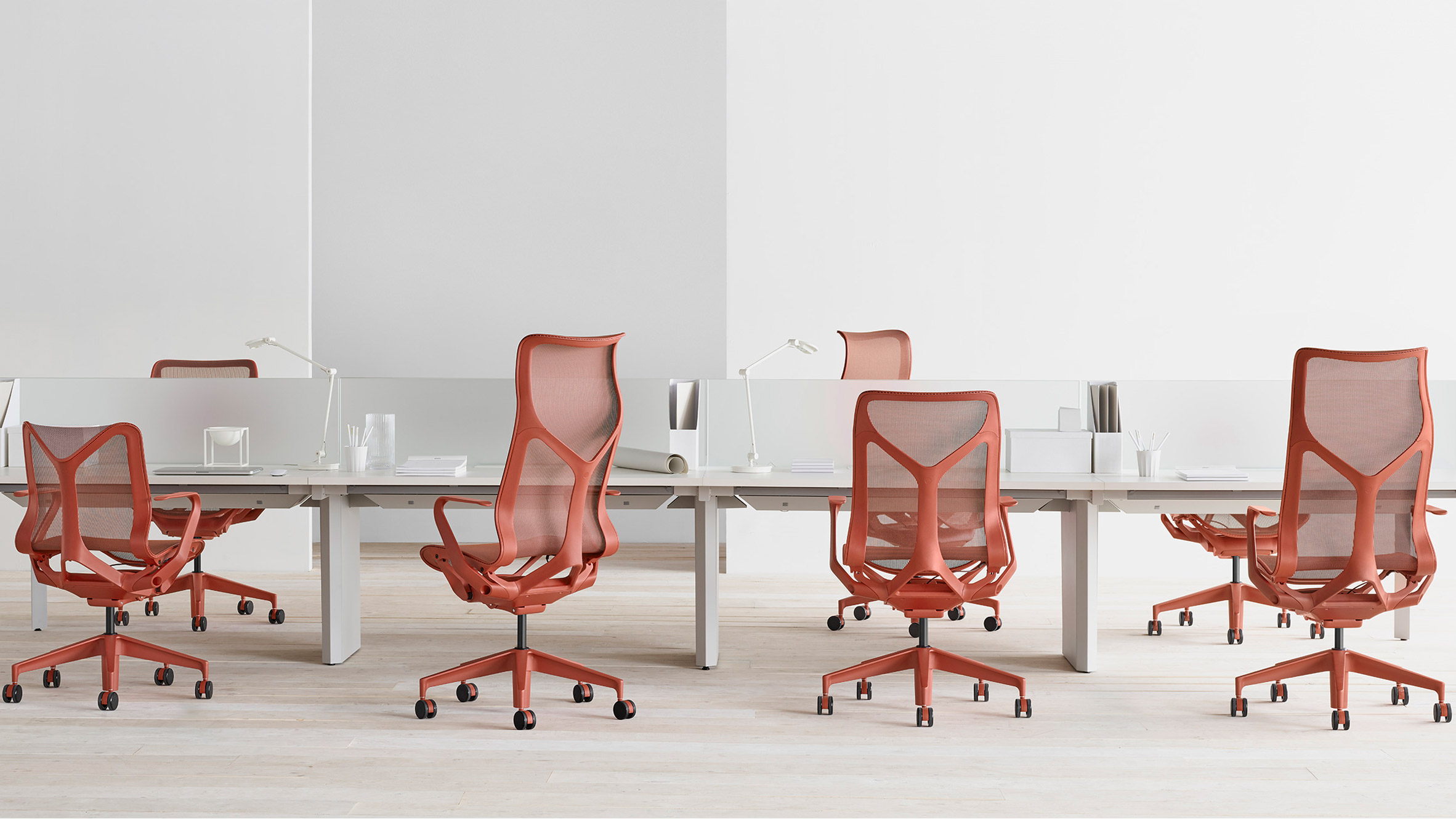
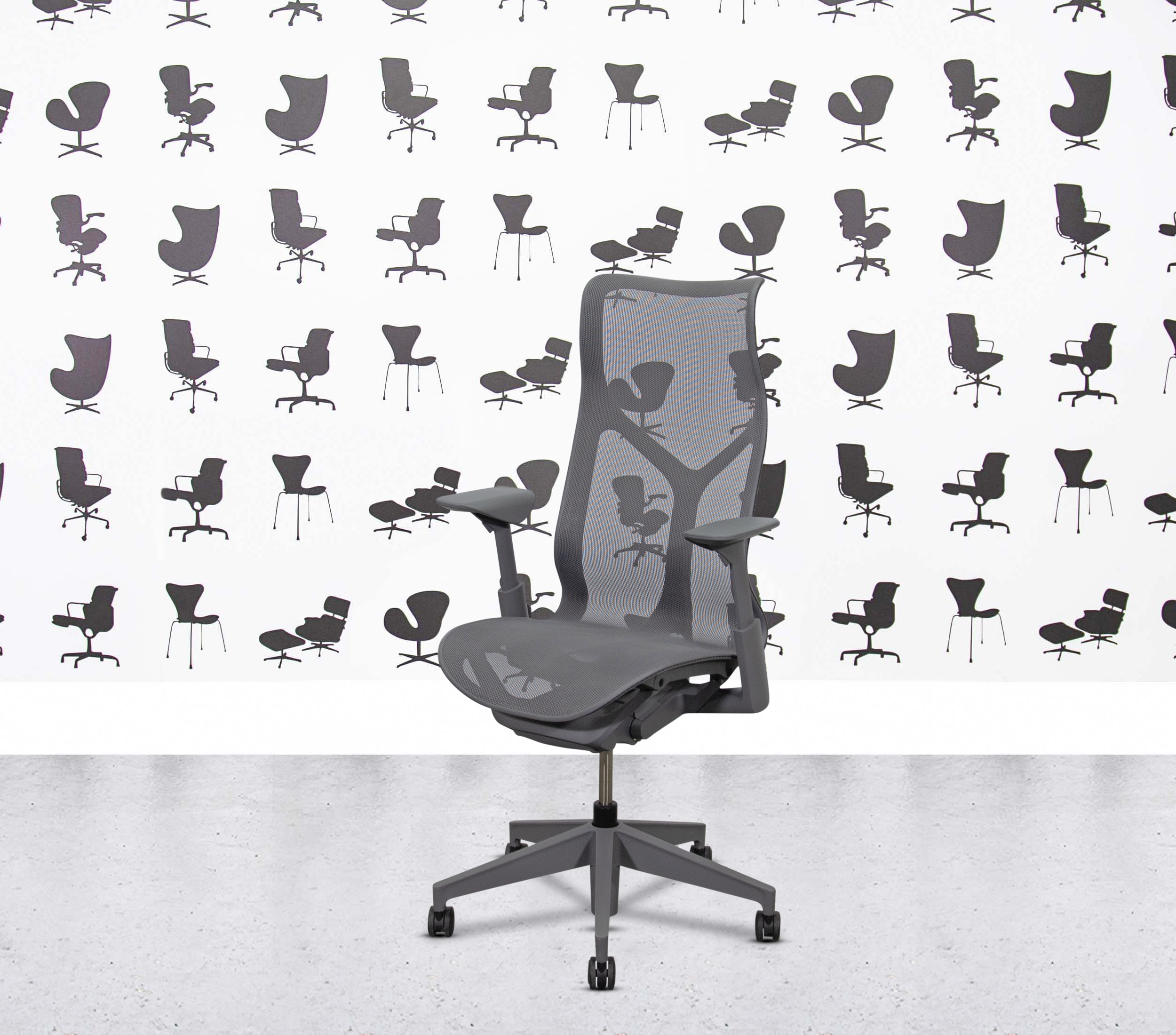
The Cosm is immediately recognizable for its monochromatic, "dipped-in-color" aesthetic. Cosm is available in one hue from top to bottom to further cement the unity of the design and the sculptural quality of the chair . The designers collaborated with Herman Miller's materials team to land on three dipped-in-color hues—Canyon, Glacier, and Nightfall , alongside neutral options like Graphite, Carbon, and Studio White. The frame, suspension mesh, arms, and base are all color-matched—an engineering feat that required precise control across metals, plastics, and textiles.
The design is clean, organic, and unadorned. Studio 7.5 calls this "industrial craftsmanship"; they like a product that is readable so that you can understand, even if you're not a mechanic or an engineer, how you're being supported . The firm explains their desire to have transparent construction and exposed parts: "We think a chair should be designed more like a bicycle, not a car" . Every curve and cutout serves a structural or ergonomic purpose, and nothing is hidden for the sake of hiding it.
Ergonomics & how it supports the body
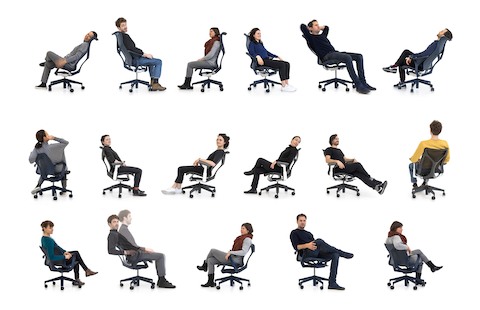
Cosm's sophisticated ergonomic design instantly responds to your body, movement, and posture to provide natural balance and total support . Cosm's Auto-Harmonic Tilt, Intercept suspension, and flexible frame work together to give you a feeling of weightlessness . The chair's philosophy is to eliminate the need for fiddling: As Studio 7.5 puts it, "comfort is the absence of awareness" —you should forget the chair is there.
The backrest and seat pan are made from Intercept suspension, a breathable mesh that flexes with you. The Intercept suspension has a continuous form that eliminates the gap between the seat and back , allowing the chair to cradle you from hip to shoulders. The frame itself is flexible: One of the biggest challenges was determining how to attach the suspension in a way that made it blend into the frame as seamlessly as possible; the answer came in the form of small "teeth" that allow the suspension material to clip into the chair's frame while staying taut for even pressure distribution . The result is distributed support that adapts to micro-movements—leaning back, shifting side-to-side, or sitting upright.
Key adjustments & mechanisms
The Cosm offers strikingly few manual adjustments—and that's by design. The only universal control is pneumatic seat height. Everything else is automatic or optional. The headline feature is the Auto-Harmonic Tilt. Studio 7.5 and Herman Miller perfected the self-adjusting tilt by inventing a complex, finely tuned mechanism; accounting for the sitter's vertical force—which is always in flux—the gears within the tilt move the fulcrum along a leaf spring to automatically adjust the chair's tension . Unlike traditional chairs where you manually set tilt tension, the Cosm's mechanism automatically calibrates resistance based on your body weight; when you sit down and lean back, it responds appropriately without any manual adjustment—the core self-adjusting feature of the Cosm's design philosophy .
There is no tilt-tension knob, no tilt lock, and no lumbar dial. Arms come in three styles: fixed, Leaf, or fully adjustable. Studio 7.5 created Cosm's Leaf Arms, which feature a soft but firm cradle design that provides a large, cozy resting place for your elbows; the sling design makes holding a phone or book natural and comfortable, and the angle of the arms means they don't get in the way of a desk when it's time to get back online . The Leaf Arms themselves are not height- or width-adjustable—another trade-off in the name of simplicity and sculptural form. There is no seat-depth slider.
Materials & build quality
The chair weighs 40 lbs and arrives fully assembled. The frame is a flexible, fiber-reinforced polymer that gives slightly under load to enhance the suspension effect. The base is aluminum or steel depending on configuration, finished in a color-matched coating. The Intercept suspension mesh is woven polyester, temperature-neutral and breathable. The main attraction of the Cosm is its build quality and design; it scores 89/100 for build quality—top three tested—and the uniform color design and clean lines are genuinely distinctive .
Reviewers consistently praise the fit and finish. One long-term owner notes, "I love that this chair looks the same as the day I got it. And it functions the same way, too. There are no signs of any of the parts degrading with age or normal use" . The dipped-in-color finish is more than cosmetic—it signals the chair's material integrity and commitment to unified design.
Sitting experience—what it actually feels like day to day
The Cosm feels different from most task chairs. It's firm—some users describe the seat as hard, particularly in extended sessions—but the suspension back is supportive and responsive. The Suspension Mesh backrest and flexible frame work together to deliver outstanding back comfort across a range of testers, earning the chair the second-highest back support score (83/100) . The Auto-Harmonic Tilt is subtle; you recline smoothly without needing to twist a knob or lean hard to overcome spring resistance. For users who fit the chair, the sensation is one of effortless balance.
One reviewer says, "The most important thing about a desk chair is that I feel good sitting in it all day, and my Cosm chair does that for me. I love that even without all the customizable features of other Herman Miller chairs, my back is happy in my chair" . Another notes, "I upgraded about five years ago, and my back has never felt better. I no longer feel sore from just sitting, though I still take breaks throughout the day. There's a noticeable difference in how my entire body feels at the end of a long day or week of work" . The absence of adjustments is liberating for some, limiting for others—especially those accustomed to dialing in lumbar depth or seat tilt.
Who it's for (and who should skip it)
The Cosm is best for users who prioritize design, build quality, and back support, and who fit the chair as-is; it's not the right call if you need adjustability, a wide scope of users, or a softer seat . It is the right chair for users who have tested it, confirmed it fits them, and value exceptional design and self-adjusting ergonomics .
Ideal for: Individual users (not hot-desking environments) who know the chair fits their frame; design-conscious professionals and studios that value aesthetics as much as function; users who prefer minimal tinkering and appreciate the "set it and forget it" ethos.
Skip if: You need extensive adjustability (lumbar depth, seat depth, tilt lock); you're outfitting a shared workspace with diverse body types; you prefer a softer, more cushioned seat; or you're budget-conscious and can find comparable ergonomics at a lower price point.
Compared to the Aeron, the Cosm scores higher on back support but lower on scope of users; the Aeron is the safer choice for a diverse office, while the Cosm is for users who know they fit it and value the aesthetic .
Comparisons with key rivals
Chair | Price tier | Back / Seat | Adjustments | Standout strength |
|---|---|---|---|---|
Herman Miller Cosm | ~$1,800+ | Mesh (Intercept suspension) | Auto-tilt, height only | Design, auto-harmonic tilt, 12-year warranty |
Herman Miller Aeron | ~$1,600+ | Mesh (Pellicle) | Extensive (lumbar, tilt, arms, seat depth) | Wider fit range, iconic status, proven track record |
Steelcase Leap | ~$1,000–$1,200 | Fabric or mesh | LiveBack, 4D arms, adjustable lumbar | All-day comfort, lower price, versatile adjustability |
Haworth Fern | ~$900–$1,100 | Mesh | Auto-tilt, wave suspension | Similar auto-adjust philosophy at lower cost |
The Cosm's self-adjusting mechanism eliminates manual setup, whereas the Aeron gives you more manual control; the Cosm is more expensive and more design-focused . The Steelcase Leap is a workhorse with broader adjustability and proven longevity. The Haworth Fern shares the auto-tilt ethos and wave-suspension aesthetic at a more accessible price, though without the Cosm's sculptural refinement or brand cachet.
Sizing, fit & configuration options
The Cosm comes in three back heights: Low-back (with its wrap top, facilitating casual movement and collaboration), Mid-back (providing scapular support and easily adapting to any setting), and High-back (fitting like a glove while providing upper-thoracic support) . There is only one seat size. The chair is engineered for a population range of 5th to 95th percentile, with a seat height range for chairs of 16.4"–20.9" . Arm options include fixed, Leaf (the sculptural suspension arms), and fully adjustable (height and width).

Color options span six hues for suspension and frame, with the option to mix and match or go monochromatic. The "dipped-in-color" variants (Canyon, Glacier, Nightfall) are the signature look; Graphite, Carbon, and Studio White offer more neutral tones. A stool variant is available for standing-height desks. Because the chair lacks size gradations (unlike Aeron's A/B/C sizing), fit is more binary: it works for you or it doesn't. Herman Miller recommends trying the chair before committing, and offers a 30-day return window.
Sustainability & certifications
Herman Miller is committed to sustainability in everything it does: the materials used, manufacturing processes, and the products' recyclability . The Cosm is ANSI and BIFMA approved , meeting industry safety and performance standards. The chair has an Environmental Product Declaration (EPD) documenting its lifecycle impacts. The EPD was based on a January 2019 LCA for Cosm Chair, independently verified in accordance with ISO 14044 and ISO 14025 .
Herman Miller does not explicitly list GREENGUARD Gold certification for the Cosm on all channels, though many Herman Miller seating products hold low-VOC certifications. The Intercept mesh and polymer frame are designed for disassembly and recyclability at end of life. The chair's long 12-year warranty encourages durability over disposability—a key sustainability lever.
Maintenance, durability & warranty
Herman Miller seating products are generally cleaned with a dry or damp rag and do not typically require maintenance during their warranted lifetime . The Intercept mesh can be vacuumed or spot-cleaned; the polymer frame wipes down easily. There are no fabric cushions to wear or compress.
Herman Miller has arguably the best office chair warranty in the industry, offering 12 years of coverage on the Cosm with no excluded parts, valid for 24/7 use for people weighing up to 350 lbs . If something goes wrong, replacement parts and on-site repairs are covered at no charge . Herman Miller offers a 30-day return policy with full refund, no restocking fees, and Herman Miller covers return shipping costs—especially valuable at the Cosm's price point .
Pricing, value & where it sits in the market
As of 2026, the Cosm starts at $1,800 (with free shipping from Herman Miller) . Configured with the High-back, Leaf Arms, and a dipped-in-color finish, the price climbs closer to $2,000. That places it at the top of the premium task-chair market, above the Aeron and well above the Steelcase Leap or Gesture.
At this price, you are paying significantly for the award-winning aesthetics . For users equipping a shared office or who need a precise ergonomic setup, the full office chair rankings will surface better options at this price point and below . One long-term user acknowledges, "The chair is admittedly expensive. Yet I think it's worth every single penny" . Value is subjective: if design and the auto-tilt experience resonate with you, the Cosm delivers. If you prioritize adjustability and fit-range per dollar, alternatives offer more bang for the buck.
Verdict—the bottom line
The Herman Miller Cosm is a bold statement in task-seating: a chair that bets on automation, aesthetics, and simplicity over the infinite-adjustability orthodoxy. The chair has won various awards since its launch, including a Red Dot Best of the Best Product Design Award in the Office Chairs category in 2019, and was listed by TIME as one of the 100 Best Inventions of the same year . Its Auto-Harmonic Tilt is genuinely innovative, its build quality is exceptional, and its monochromatic design is unlike anything else in the category.
But the Cosm is not a universal solution. Its lack of manual adjustments and single-size seat mean fit is narrower than chairs like the Aeron or Leap. The firm seat won't please everyone, and the premium price demands that you genuinely value what it offers. For the right user—someone who knows the chair fits, who prizes design as much as function, and who wants to sit down and simply work without fiddling—the Cosm is a revelation. For everyone else, it's a beautiful, expensive curiosity worth trying but not necessarily buying.
Sources & references
Interested in the Herman Miller Lino?
Check the price on Amazon