Hbada P5
Budget ergonomics meet everyday comfort in a footrest-equipped task chair
Overview
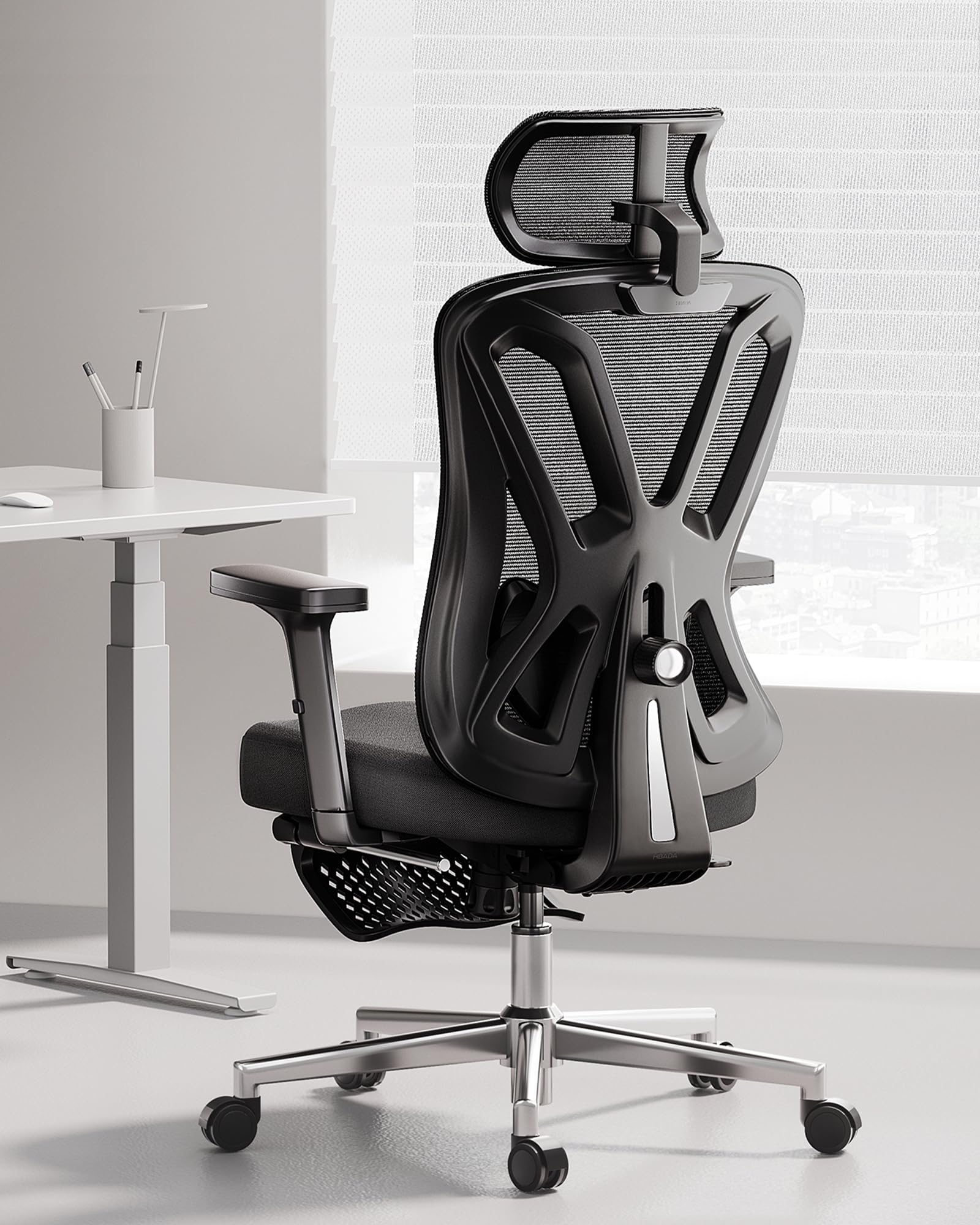
The Hbada P5 is a budget-focused ergonomic task chair designed for home offices and smaller workspaces that prioritize adjustability and comfort without venture-capital pricing. Marketed as offering "enhanced support and sleek design for smaller setups with footrest," the P5 sits within Hbada's P-Series lineup—the brand's entry-level ergonomic collection positioned below their flagship E3 and X7 models. The chair features an S-shaped mesh backrest, 2D adjustable lumbar support that moves up, down, forward, and backward, a 2D headrest, 2D armrests, and a retractable footrest —a feature set that punches above typical sub-$200 task chairs.
At a glance
Brand | Hbada |
|---|---|
Model | P5 |
Price tier | Budget ($150–$180 USD typical street price) |
Backrest | Breathable mesh, S-shaped, full-height |
Seat cushion | 16 independent springs, 1.18-inch memory foam, 3.54-inch total depth, curved wooden board base, mesh covering |
Lumbar support | 2D adjustable (up/down, forward/backward) |
Headrest | Adjustable height (3.94 inches range), 40° rotation |
Armrests | 2D adjustable (height, angle) |
Recline | Up to 135°, tilt lock function |
Footrest | Retractable, integrated beneath seat |
Height adjustment | 3.35-inch range (pneumatic gas lift) |
Weight capacity | 300 pounds |
Certifications | SGS, BIFMA |
Warranty | 5-year on major components, 30-day return policy |
Assembly | Required; all tools and hardware included |
The brand & its philosophy
Hbada has 16 years of ergonomic chair manufacturing experience and positions itself as a value-oriented alternative to premium brands like Herman Miller and Steelcase. The company manufactures in China and sells globally through direct-to-consumer channels and third-party marketplaces, primarily Amazon. Hbada describes the P-Series as providing "essential ergonomic support in a compact, stylish design" aimed at "budget-friendly home offices."
The brand's philosophy emphasizes democratizing ergonomic features—adjustable lumbar support, breathable mesh, multi-axis adjustments—that were once exclusive to corporate procurement budgets. While Hbada has recently expanded into higher-end territory with the AI-powered X7 and 3-zone lumbar E3 Pro, the P-Series remains its volume workhorse, targeting remote workers, students, and small businesses seeking certified, adjustable seating without four-figure outlays.
The designer and the design story
Hbada does not publicly attribute the P5 to a specific industrial designer or design studio. The chair appears to be the work of the company's in-house engineering team, developed through iterative refinement of earlier P-Series models (P1, P2, P3). The design story is one of feature accretion rather than singular vision: the P5 differentiates itself from the footrest-free P1 by adding the retractable leg support, while retaining the core ergonomic architecture shared across the family.
The focus was evidently practical rather than conceptual—how to pack adjustable lumbar, a headrest, armrests, and a footrest into a sub-$200 bill of materials while meeting BIFMA safety thresholds. The result is a chair that prioritizes function density over design authorship, a common approach in the value-ergonomics segment where brand engineering teams dominate and celebrity designers are absent.
Design language & aesthetics
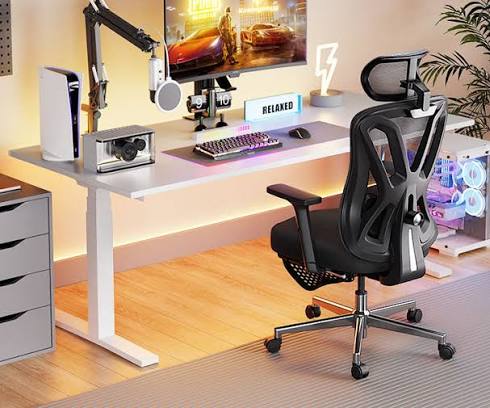
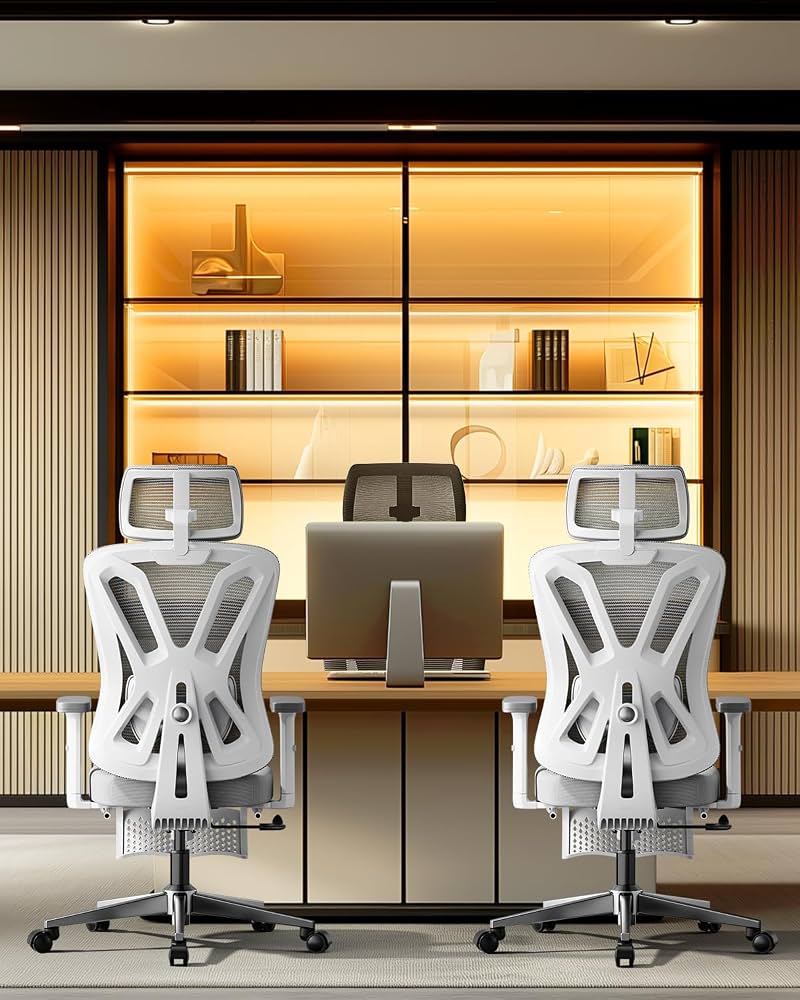
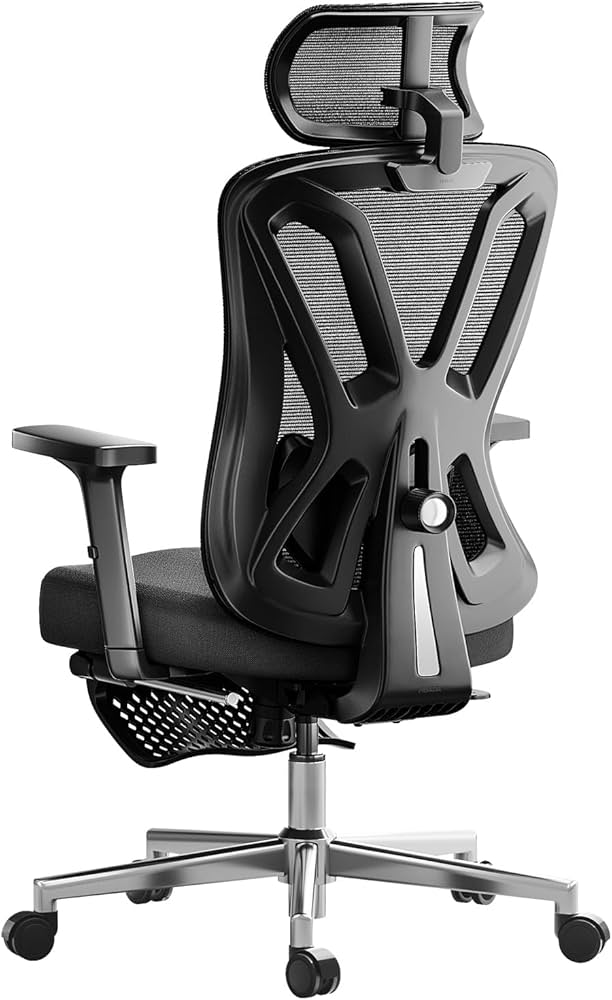
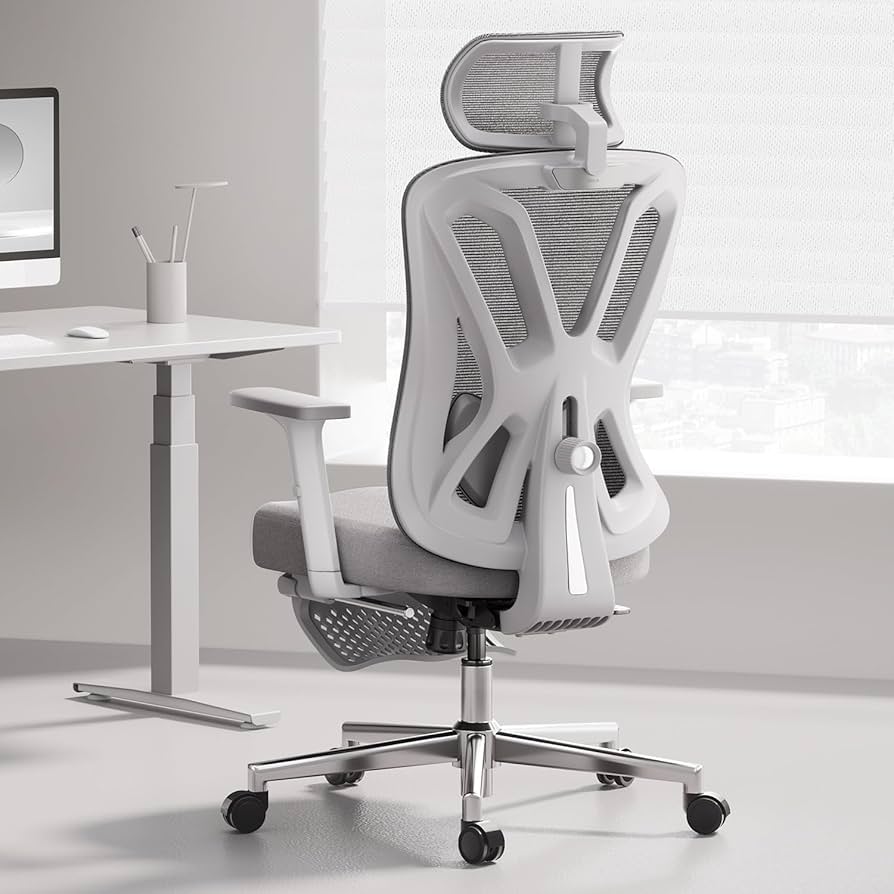
The P5 speaks the visual dialect of contemporary budget ergonomics: black mesh, matte plastic, exposed aluminum or steel components, and a profile that reads "task chair" rather than executive throne. The S-shaped backrest curves to mirror spinal contour, and the overall aesthetic is functional minimalism—no bold color blocking, no gaming-chair aggression, no Bauhaus flourishes.
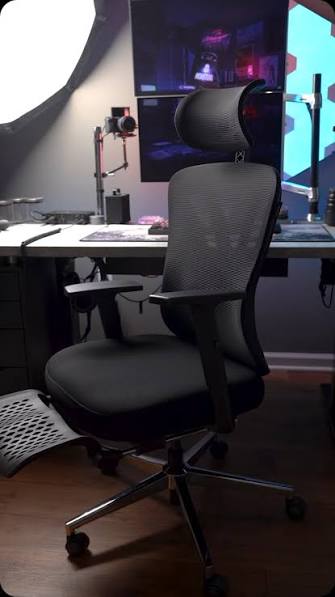
The mesh back is taut and frameless at the perimeter, stretched over an internal support structure. The footrest tucks neatly beneath the seat pan when retracted, maintaining a clean side profile. Armrests are simple padded caps on height-adjustable posts. The base is a standard five-star nylon configuration with 360° casters. It's a look designed to blend into home offices, not dominate them—appropriate for Zoom backgrounds and tight quarters alike.
Ergonomics & how it supports the body
The chair provides comprehensive support for back, lumbar, hips, and arms, with an S-shaped backrest that contours to the spine to promote neutral posture during extended sitting. The 2D lumbar support moves vertically and in depth, designed to align with the natural curve of the spine and reduce lower-back strain.
The seat cushion comprises 16 independent springs and 1.18-inch memory foam designed to maintain shape after extended use, with the spring layer intended to distribute pressure and prevent the "hammock sag" common in cheaper foam-only seats. Breathable mesh fabric covering prevents heat buildup during prolonged sitting. The headrest provides cervical support, though its range of motion is more limited than premium 3D or 4D units.
Owner feedback consistently highlights lumbar adjustability and footrest utility as the P5's ergonomic standouts, though some taller users report the headrest sitting slightly low even at maximum extension.
Key adjustments & mechanisms
The P5 offers a practical, if not exhaustive, suite of adjustments:
Lumbar support: 2D adjustable—vertical sliding along the backrest and forward/backward depth adjustment via knob to dial in lower-back pressure.
Seat height: 3.35-inch pneumatic range, actuated by a lever beneath the right side of the seat.
Recline: Backrest tilts up to 135° with a lock mechanism for upright work or relaxed breaks. Tilt tension is not user-adjustable on this model.
Headrest: Adjusts 3.94 inches vertically and rotates 40° to accommodate varying neck angles.
Armrests: 2D—height and inward/outward angle. Not width- or front/back-adjustable, limiting customization for broader or narrower frames.
Footrest: Pull-out, retractable design. User reviews note the footrest is "solid and does not feel flimsy," a common concern with budget-chair add-ons.
Absent are seat-depth adjustment and advanced synchro-tilt or knee-tilt mechanisms found on pricier chairs. The tilt is center-pivot, meaning the seat pan and backrest recline together.
Materials & build quality
The seat comprises a 3.54-inch cushion layer (16 independent springs plus 1.18-inch memory foam), a curved wooden board structure, and black mesh covering. Breathable mesh prevents sweating after prolonged sitting. The backrest mesh is a single-layer weave, less premium than the triple-layer or 4-way elastic mesh on higher-end Hbada models, but adequate for ventilation.
The frame is steel and nylon composite. The chair has passed SGS certification and BIFMA testing, indicating it meets North American safety and durability standards for commercial seating. Weight capacity is rated at 300 pounds. Owner reports suggest solid initial build quality, though long-term durability (mesh tension retention, spring longevity) remains unproven given the model's relatively recent market entry.
Casters are standard 60mm nylon; the gas lift is Class 4 (the BIFMA-required safety standard). User reviews note materials "do not feel cheap compared to other chairs," a recurring theme in owner feedback.
Sitting experience—what it actually feels like day to day
The P5's sitting experience is best characterized as supportive-but-firm rather than plush. The 16-spring and memory-foam cushion is described as "as relaxing as a sofa" with "just the right softness to maintain its shape," though users accustomed to thick executive padding may find it initially unyielding. The spring layer becomes more apparent (and appreciated) after hours of continuous use, when foam-only seats begin to bottom out.
Owner reviews praise "excellent lumbar support" and note "the adjustable height and reclining function make it easy to customize for different working positions," with the footrest adding "extra comfort when you want to relax." One reviewer reported being surprised by the footrest: "the leg rest cradled my calf's," and the mesh back keeps the chair "cool" compared to leather alternatives.
The mesh back breathes well but lacks the premium "disappearing" quality of Herman Miller Aeron-grade elastomer; you're aware you're sitting against fabric. Recline feel is smooth, though the lack of adjustable tilt tension means heavier users may find the backrest gives too easily, while lighter users might want less resistance. The footrest, while sturdy, extends at a fixed angle—comfortable for most, but not optimized for very tall or very short users.
Who it's for (and who should skip it)
The P5 is ideal for:
Remote workers and students seeking ergonomic adjustability on a $150–$180 budget, especially those working 4–8 hour days who want lumbar support and occasional recline-with-footrest breaks.
Compact-space users. Hbada markets the P5 for "smaller setups," and its footprint and clean lines suit apartments, dorm rooms, and multipurpose rooms.
Footrest enthusiasts. If you've been hunting for a task chair with an integrated leg rest under $200, the P5 is one of very few certified options.
First-time ergonomic buyers upgrading from flat-pack or gaming chairs who want to test adjustable lumbar and mesh backs without premium commitment.
Skip the P5 if you:
Sit 10+ hours daily. The P5's 2D adjustments and mid-tier cushioning are better suited to moderate rather than marathon sessions; heavy-duty sitters should consider the Hbada E3 or dedicated task chairs with deeper adjustment ranges.
Need advanced tilt or seat-depth adjustment. The P5 lacks synchro-tilt, knee-tilt, and seat-slider mechanisms—if fit customization is critical, look to chairs with 4D armrests and more granular controls.
Are very tall (6'3"+) or very short (under 5'2"). Hbada states the chair is "suitable for people 5' to 5'85" tall," and outside that range, headrest and footrest positioning may not align comfortably.
Prefer executive aesthetics or leather upholstery. The P5 is unabashedly a mesh task chair; if you want padded leather or high-back gravitas, this isn't your chair.
Comparisons with key rivals
Chair | Price tier | Lumbar / Adjustments | Footrest? | Standout strength |
|---|---|---|---|---|
Hbada P5 | ~$150–$180 | 2D lumbar, 2D armrests, 135° recline | Yes, retractable | Footrest + spring cushion at budget price |
Amazon Basics Mid-Back Mesh | ~$80–$100 | Fixed lumbar, fixed armrests | No | Rock-bottom price, adequate for light use |
Hbada E3 | ~$280–$320 | 3-zone dynamic lumbar, 3D armrests | Optional | Premium Hbada adjustability, longer sitting endurance |
Sihoo M18 | ~$160–$190 | 2D lumbar, flip-up armrests, 135° recline | No | Similar spec, no footrest but slightly more premium mesh |
The P5 carves out a niche by bundling a footrest with BIFMA-certified ergonomics at a price point where most competitors omit the leg rest entirely. Against the Amazon Basics, it's a clear upgrade in adjustability and certification. Against the Hbada E3, it's the budget sibling—fewer adjustment axes, simpler cushioning, but 40% less expensive. The Sihoo M18 is perhaps the closest peer, but lacks the integrated footrest that defines the P5's value proposition.
Sizing, fit & configuration options
Hbada specifies the P5 is "suitable for people 5' to 5'85" tall," with a 3.35-inch seat-height adjustment range. Weight capacity is 300 pounds. The chair is offered in black only; no alternate colorways or upholstery options are available. There is no "big and tall" variant—users approaching or exceeding the weight limit should consider the Hbada E3 Air, which is engineered for larger frames.
The armrests adjust in height and angle but not width, which may feel cramped for broader-shouldered users or too wide for petite frames. The footrest extends to a fixed length and angle, comfortable for average leg lengths but potentially awkward for users significantly taller or shorter than the target range.
Sustainability & certifications
The P5 has passed SGS certification and BIFMA testing, confirming compliance with North American commercial furniture safety and performance standards. BIFMA X5.1 covers structural strength, stability, and durability under typical use conditions. The chair does not carry GREENGUARD or GREENGUARD Gold certification for low chemical emissions, nor does Hbada make explicit sustainability or carbon-offset claims for the P-Series.
Materials are not marketed as recycled-content, and end-of-life recyclability is not highlighted in product documentation. Packaging design earned "Compact by Design" recognition from Amazon, indicating reduced packaging volume and shipping efficiency to lower carbon emissions. For buyers prioritizing environmental credentials, the P5 offers baseline safety compliance but not the proactive green certifications found on higher-tier chairs from brands like Steelcase or Herman Miller.
Maintenance, durability & warranty
Routine maintenance is straightforward. Cleaning involves wiping with a damp cloth and avoiding harsh chemicals or abrasives that may damage mesh or other materials. If the chair becomes wobbly, check and tighten all assembly screws and verify the base and gas cylinder are properly seated. Squeaking can be addressed with a small amount of lubricant on moving parts or pivot points; stiff footrest operation similarly benefits from lubricant on sliding mechanisms.
All Hbada chairs come with a comprehensive 5-year warranty covering component defects. The brand offers a 30-day no-reason return policy, allowing users to test-drive the chair at home. For verified quality issues, Hbada provides fast replacement parts rather than requiring full returns or repairs. Some retailers list a 36-month (3-year) parts warranty, so warranty duration may vary by purchase channel—buyers should confirm terms at checkout.
Long-term durability reports are limited given the chair's relatively recent release, but BIFMA certification suggests the frame and mechanisms should withstand typical home-office use for several years. Mesh tension retention and spring cushion longevity remain open questions best answered by owners who've logged 18+ months of daily sitting.
Pricing, value & where it sits in the market
The Hbada P5 typically retails between $150 and $180 USD on Amazon, Newegg, and the Hbada direct site, with periodic sales dipping below $150. At this price, it occupies the upper tier of the budget ergonomic category—more expensive than bare-bones Amazon Basics or Furmax chairs ($80–$120) but significantly cheaper than mid-market stalwarts like the Hon Ignition 2.0 (~$400) or Steelcase Series 1 (~$500+).
The value proposition hinges on feature density: 2D lumbar, 2D headrest, 2D armrests, 135° recline, spring-cushioned seat, and a retractable footrest—all with BIFMA certification—for under $200. Competitors at similar price points typically omit at least one of those features (most commonly the footrest or adjustable lumbar). The chair holds a 4.8-star rating on Hbada's site with 57 reviews, indicating strong owner satisfaction in its category.
For buyers willing to stretch another $100–$150, the Hbada E3 or Sihoo Doro S300 offer deeper ergonomic refinement (3D lumbar, better mesh, synchro-tilt). But if the budget ceiling is firm and a footrest is non-negotiable, the P5 delivers more certified chair per dollar than most alternatives.
Verdict—the bottom line
The Hbada P5 is a pragmatic, feature-forward task chair that succeeds precisely because it doesn't try to be more than it is. It won't compete with the Steelcase Leap or Herman Miller Aeron on adjustment granularity, materials refinement, or brand cachet—but for $150–$180, it wasn't designed to. Instead, it offers BIFMA-certified ergonomics, a 16-spring cushion, adjustable lumbar support, and a retractable footrest in a package that fits both tight spaces and tight budgets.
The spring-cushioned seat and breathable mesh back distinguish it from foam-slab competitors, and the footrest—still rare in this price band—adds genuine daily utility for users who like to recline during breaks or phone calls. Owners consistently praise the lumbar support and customization options, and the 5-year warranty provides reassurance beyond the typical 1–2 years at this tier.
For home-office workers who sit 4–8 hours daily and want adjustable ergonomics without premium pricing, the Hbada P5 is one of the most complete packages under $200—especially if a footrest matters to you.
It's not a chair for marathon sitters, very tall or very short users, or anyone seeking Herman Miller-grade mesh and infinite adjustability. But for students, remote employees, and small-business owners upgrading from flat-pack furniture or aging gaming chairs, the P5 hits a sweet spot of function, comfort, and value that's hard to ignore.
Sources & references
Interested in the Hbada P5?
Check the price on Amazon